
Some links on this page are affiliate links. If you buy through them I may earn a commission, at no extra cost to you. It never changes a rating. Read the disclosure
- AccuRanker updates daily with on-demand refresh; Ahrefs Rank Tracker updates weekly by default.
- At 2,000 keywords both cost $249 a month; Ahrefs adds a full SEO suite, AccuRanker adds daily data.
- AccuRanker includes unlimited users; Ahrefs charges $40 to $80 a month per extra user.
- AccuRanker also tracks Bing and YouTube; Ahrefs Rank Tracker tracks Google.
- Many agencies use both: Ahrefs for research and backlinks, AccuRanker for daily tracking.
AccuRanker vs Ahrefs is really a question about rank tracking. AccuRanker is a dedicated rank tracker that updates every keyword daily and lets you refresh on demand. Ahrefs is a full SEO suite whose Rank Tracker updates weekly by default, alongside backlinks, keyword research and site audits. Both are excellent; they’re built for different jobs.
If daily rankings are the core of your work (client reporting, big sites, fast-moving keywords), AccuRanker is the better tool. If you need one subscription for most of your SEO and a weekly view of rankings is enough, Ahrefs gives you far more for the money. This comparison sticks to rank tracking: how often each updates, where and on which devices it tracks, competitors, reporting and price at the same number of keywords. Every fact comes from the companies’ own pages, checked on the date at the end.
AccuRanker vs Ahrefs at a glance
| Feature | AccuRanker | Ahrefs Rank Tracker |
|---|---|---|
| What it is | Dedicated rank tracker | One tool in a full SEO suite |
| Update frequency | Daily, plus on-demand refresh | Weekly by default on every plan |
| Locations | Country, city or address | Country, city or ZIP code |
| Search engines | Google, Bing, YouTube and more | |
| Users | Unlimited on every plan | 1 included; extra users from $40 a month each |
| 2,000 keywords | $249 a month ($224 paid yearly) | Standard, $249 a month ($208 paid yearly) |
| Smallest plan | 2,000 keywords | Lite, 750 keywords, $129 a month |
| Try before you pay | Demo, then a 14-day refund policy | No trial or discounts; Ahrefs Free for your own site |
Prices in US dollars before tax, from each company’s pricing page when this guide was updated.

Update frequency: daily vs weekly
This is the difference that decides most comparisons. AccuRanker updates every tracked keyword daily on every plan, and you can refresh a single keyword or a whole domain on demand, as often as every two hours. If you publish a page in the morning or Google rolls out an update, you can see the effect the same day.
Ahrefs says in its help centre that the default update frequency in Rank Tracker is weekly on all subscription plans, and its pricing page lists “Weekly” for every plan from Lite to Enterprise. Your setting is shown under Limits & Usage in Account Settings. Ahrefs’ blog has mentioned switching to daily tracking, but the current pricing page doesn’t list it as an option, so if you need daily data from Ahrefs, confirm the cost with Ahrefs before you buy.
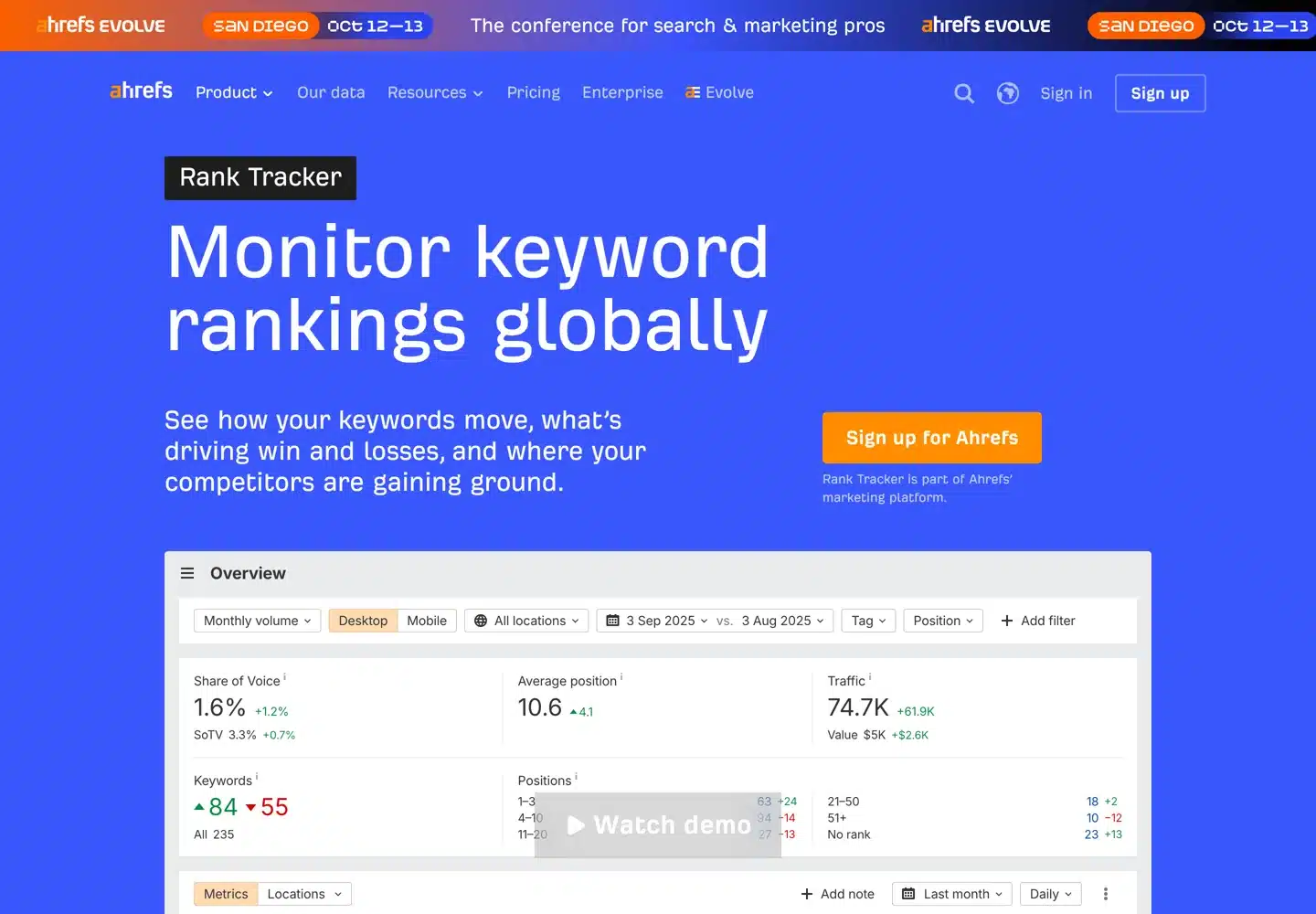
Does weekly matter? For a blog checking whether a rewritten article climbs over a month, weekly is fine. Ahrefs also keeps a daily SERP history chart for SERP features, and its Site Explorer shows organic keywords for any site, updated on its own schedule. For an agency reporting to clients, a store watching product pages during a sale, or anyone tracking a Google update day by day, weekly data arrives too late.
Locations, devices and search engines
Both tools track local results. AccuRanker lets you choose a country, a city or a specific address, on mobile and desktop. Ahrefs Rank Tracker tracks by country, city or ZIP code across more than 190 locations, also on mobile and desktop.
The difference is the search engines. Ahrefs Rank Tracker tracks Google. AccuRanker also tracks Bing, YouTube and other engines, which matters if you have a YouTube channel or markets where Google isn’t the only search engine. The YouTube rank checker guide covers AccuRanker’s YouTube tracking and its alternatives.

On SERP features, AccuRanker tracks more than 45 types and shows AI Overviews for your keywords, including whether your page is cited. Ahrefs shows SERP features in its position history and a daily SERP history chart, warns you when another page outranks the target URL you set for a keyword, and flags when several of your pages rank for one keyword (keyword cannibalisation).
Competitors and share of voice
Ahrefs lets you compare your site with 10 competitors for rankings, traffic and SERPs, and spots “newcomers” and fast climbers in your results. It shows share of voice as the percentage of organic clicks and traffic value you own in the market, and groups your rankings into positions 1–3, 4–10, 11–20, 21–50 and 51–100.

AccuRanker shows Share of Voice for each domain, with click-through rates estimated from more than 120 parameters on its higher plans (AI CTR on Expert), so the number reflects the real layout of each results page rather than a fixed curve. It also tracks competitors per domain. For agencies, the bigger difference is tagging: AccuRanker’s tags and dynamic tags (Expert plan) let you split thousands of keywords by client, product line or page type.
Where the ranking data comes from
Both tools check the search results themselves, but Ahrefs has two places that show rankings, and they often disagree. Knowing why saves a lot of confusion.
- Ahrefs Rank Tracker checks only the keywords you add, in the locations you choose, on its weekly schedule. History starts the day you add a keyword.
- Ahrefs Site Explorer → Organic keywords is filled in automatically from Ahrefs’ keyword database. You can’t choose the keywords or the location, and each keyword is refreshed anywhere from daily to every few months, depending on its search volume.
So a keyword can show position 8 in Site Explorer and position 12 in Rank Tracker simply because the two were checked on different days or in different places. For anything you report on, use Rank Tracker.
AccuRanker has only one source: the keywords you track, checked daily from the location you set. The company says its data is 99.9% accurate and that it runs servers in every country it supports. That’s its own claim, but the practical point stands: one daily number per keyword, per location, per device, with nothing to reconcile.
Reporting, users and integrations
This is where AccuRanker is clearly built for agencies:
- Users: AccuRanker doesn’t charge for extra users. Ahrefs includes one user per plan and charges $40, $60 or $80 a month for each extra user, depending on the plan.
- Reports: AccuRanker includes reporting and export on every plan, and a Google Data Studio connector on Expert. Ahrefs has a Report Builder on every plan and a Looker Studio integration on Advanced and up.
- API: AccuRanker’s read API is unlimited on Expert, with BigQuery and a write API on Enterprise. Ahrefs includes API and MCP access on every plan, with limits by plan.
For a freelancer working alone, Ahrefs’ single user is no problem. For a team of five, the user charges add up quickly, and AccuRanker’s unlimited users become a real saving.
AccuRanker vs Ahrefs pricing at the same number of keywords
The fair way to compare prices is at the same number of tracked keywords, remembering that the Ahrefs price also buys a full SEO suite and the AccuRanker price buys daily data.
| Keywords | AccuRanker (daily) | Ahrefs (weekly) |
|---|---|---|
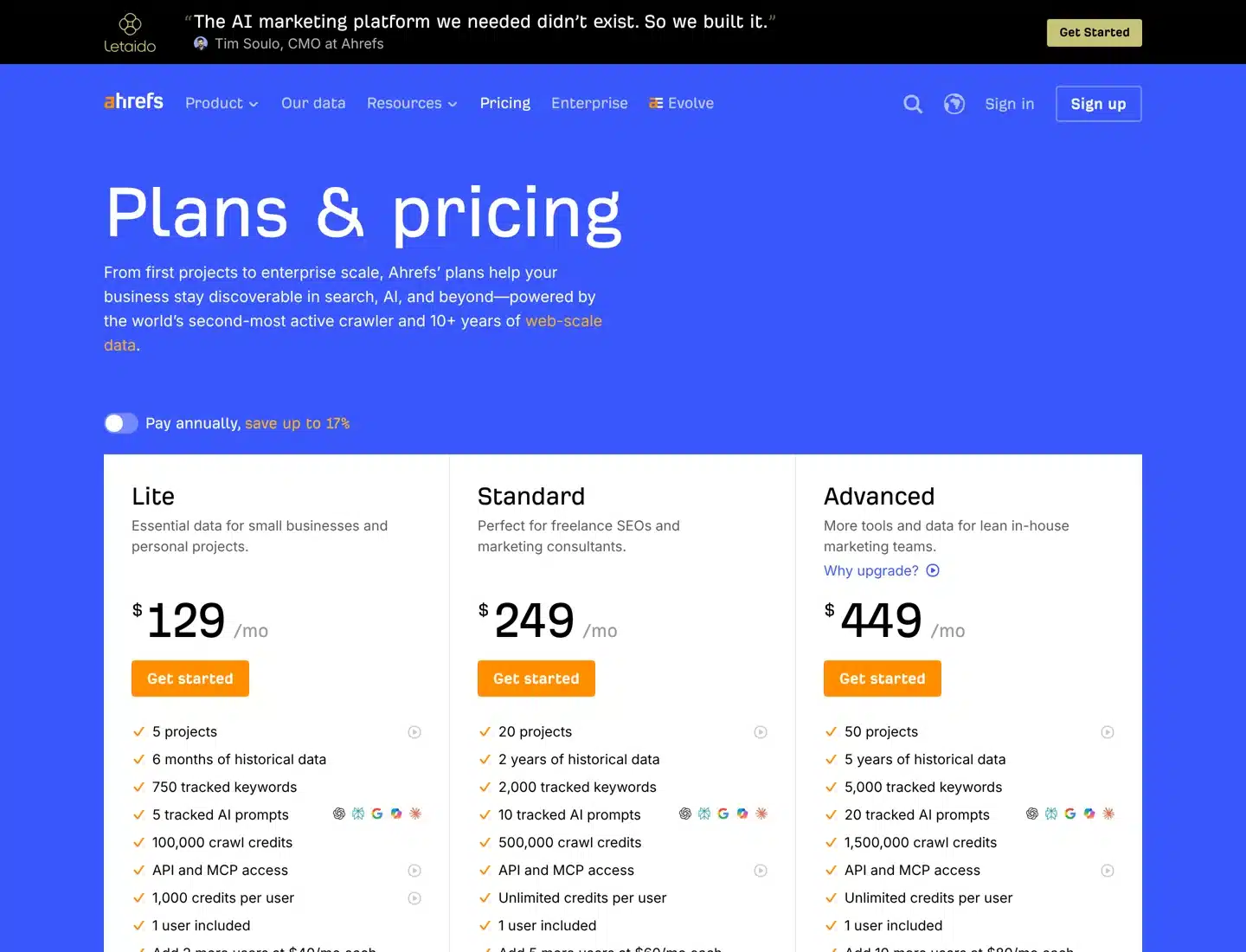
| 750 | No plan this small (starts at 2,000) | Lite: $129 a month, $108 paid yearly |
| 2,000 | $249 a month, $224 paid yearly | Standard: $249 a month, $208 paid yearly |
| 5,000 | $609 a month, $548 paid yearly | Advanced: $449 a month, $374 paid yearly |
| 10,000 | Expert: $849 a month, $764 paid yearly | Enterprise: $1,499 a month, yearly only |
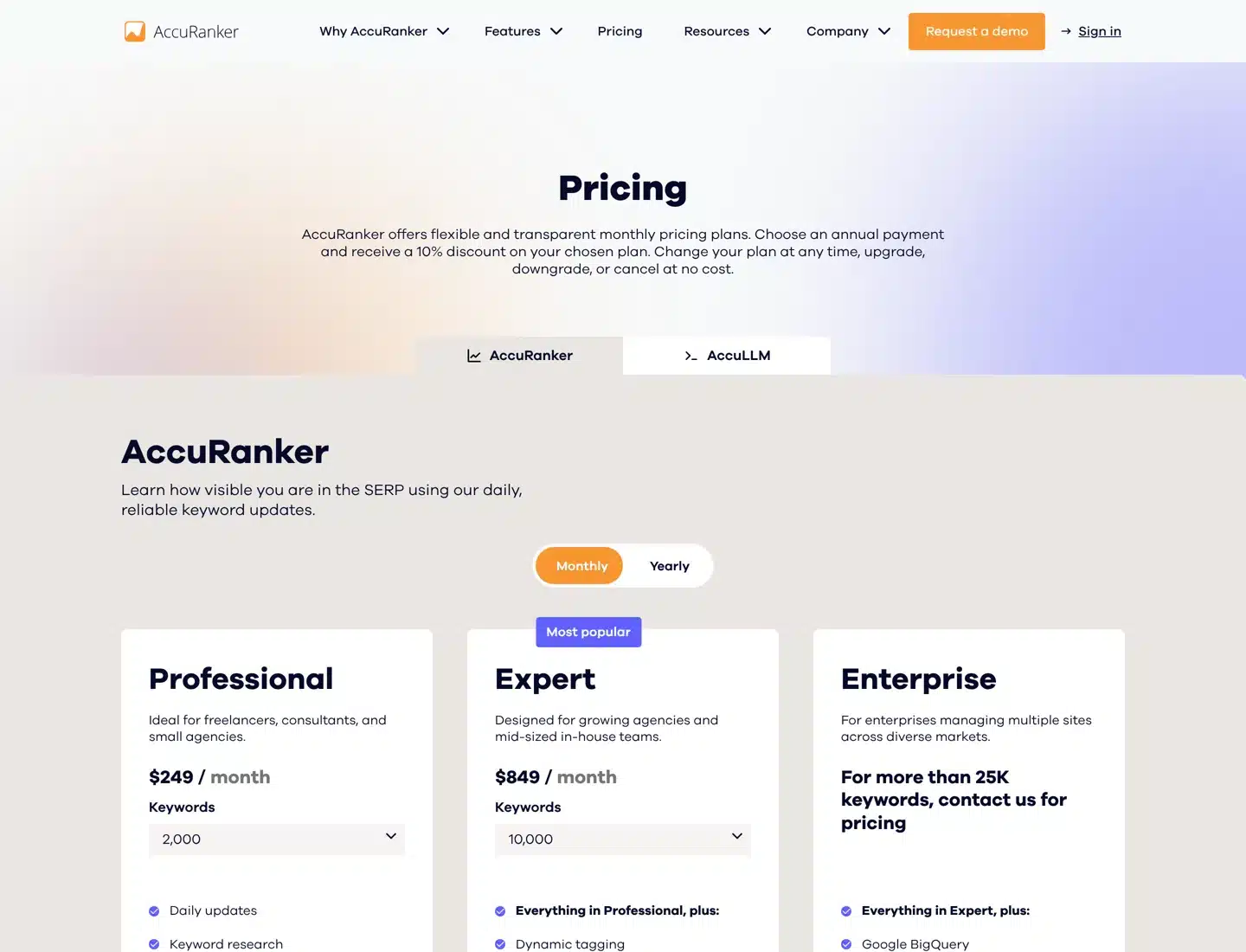
At 2,000 keywords the monthly price is the same, $249. With AccuRanker you get daily updates and unlimited users; with Ahrefs you get weekly updates plus Site Explorer, Keywords Explorer, Site Audit and the rest of the suite. Above 5,000 keywords Ahrefs is cheaper until its Enterprise plan, where AccuRanker becomes the cheaper option by a wide margin.
Neither offers a free trial. AccuRanker asks you to book a demo and has a 14-day refund policy. Ahrefs says it never runs discounts or trials; Ahrefs Free gives website owners limited access to Site Explorer and Site Audit. The AccuRanker deals page lists any current offer.
Switching between them
Moving tools usually means losing your ranking history, which is why many people stay with a tool they’ve outgrown. Both make it easier than it used to be:
- Into Ahrefs: Rank Tracker can import keyword rankings from Site Explorer with their ranking history, across more than 190 locations, so a new project doesn’t start from zero.
- Into AccuRanker: you can import keywords and data from your previous tool, or straight from Google Search Console when you add a domain.
Whichever way you move, run both tools side by side for a few weeks before you cancel the old one. You’ll see how their positions line up for your keywords and keep an unbroken record for reports.
Using AccuRanker and Ahrefs together
Many agencies use both, and it isn’t wasteful: they overlap only in rank tracking. A common setup is Ahrefs for backlinks, keyword research and competitor research, and AccuRanker for daily rankings and client reports. Ahrefs’ Lite plan ($108 a month paid yearly) plus AccuRanker’s 2,000-keyword plan ($224 a month paid yearly) costs $332 a month, for the strongest backlink data and daily tracking side by side.
If backlinks are the main reason you’d buy Ahrefs, the best backlink checker tools guide compares it with Semrush, SE Ranking and Majestic.
Which should you choose?
- Choose AccuRanker if rank tracking is your core job: daily data, on-demand refresh, unlimited users, YouTube and Bing tracking, and client reporting at scale.
- Choose Ahrefs if you need one SEO tool for backlinks, keyword research and audits, and weekly rankings are enough.
- Choose both if you run an agency and need the best of each.
- Choose neither yet if you track a few hundred keywords on a budget. SE Ranking tracks 2,000 keywords daily for $129 a month, and Semrush tracks 500 keywords daily on its $139 SEO plan, both with free trials.
The full AccuRanker review covers its other features (AccuLLM, AI search volume, the keyword database), and the rank tracking tools guide compares more trackers side by side.
Questions people ask
Is AccuRanker better than Ahrefs?
For rank tracking, yes: AccuRanker updates every keyword daily, lets you refresh on demand and includes unlimited users. Ahrefs is the better buy if you need backlinks, keyword research and site audits in one tool and weekly rankings are enough.
How often does Ahrefs Rank Tracker update?
Weekly. Ahrefs' help centre says the default update frequency in Rank Tracker is weekly on all subscription plans, and its pricing page lists weekly for every plan. You can check your setting under Limits & Usage in Account Settings.
Which is cheaper, AccuRanker or Ahrefs?
For fewer than 2,000 keywords, Ahrefs, because its Lite plan starts at $129 a month for 750 keywords and AccuRanker starts at 2,000. At 2,000 keywords both cost $249 a month. At 10,000 keywords AccuRanker is cheaper: $849 a month against Ahrefs Enterprise at $1,499.
Does Ahrefs have a free trial?
No. Ahrefs says it never runs discounts or free trials. Ahrefs Free gives website owners limited access to Site Explorer and Site Audit. AccuRanker has no free trial either, but offers a demo and a 14-day refund policy.
Can I use AccuRanker and Ahrefs together?
Yes, and many agencies do. Ahrefs covers backlinks, keyword and competitor research; AccuRanker covers daily rank tracking and client reports. Ahrefs Lite plus AccuRanker's 2,000-keyword plan costs $332 a month paid yearly.
Why do Ahrefs Rank Tracker and Site Explorer show different positions?
They're different data. Rank Tracker checks only the keywords you add, in your chosen locations, weekly. Site Explorer's Organic keywords report is filled in automatically from Ahrefs' database and refreshes each keyword on its own schedule, from daily to every few months.
Sources
- How frequently do my tracked keywords get updated? (Ahrefs Help) help.ahrefs.com · checked October 11, 2026
- Rank Tracker vs Site Explorer's Organic Keywords report (Ahrefs Help) help.ahrefs.com · checked October 11, 2026
- Ahrefs Rank Tracker ahrefs.com · checked October 11, 2026
- Ahrefs plans and pricing ahrefs.com · checked October 11, 2026
- AccuRanker pricing www.accuranker.com · checked October 11, 2026
- AccuRanker rank tracking www.accuranker.com · checked October 11, 2026
- AccuRanker SERP analysis (SERP features, AI Overviews) www.accuranker.com · checked October 11, 2026
- AccuRanker: new Share of Voice (search engines) www.accuranker.com · checked October 11, 2026
- AccuRanker: keyword rank tracking for YouTube channels www.accuranker.com · checked October 11, 2026
- SE Ranking pricing seranking.com · checked October 11, 2026
- Semrush SEO plans and pricing www.semrush.com · checked October 11, 2026

Building websites since 2006: 500+ web projects of every size and $300K+ in website deals sold or brokered. Founder of A Digital Motive and DigiFlippers. I share the whole process here, plainly.
Founder of A Digital Motive and DigiFlippers