Some links on this page are affiliate links. If you buy through them I may earn a commission, at no extra cost to you. It never changes a rating. Read the disclosure
- SE Ranking tracks 2,000 keywords daily for $129 a month, the lowest cost per keyword here.
- AccuRanker updates daily and on demand every two hours, with unlimited users.
- Ahrefs Rank Tracker updates weekly by default; Mangools updates weekly except on Agency.
- Semrush tracks 500 keywords on its $139 plan, so you pay mainly for research.
- Google Search Console is free and shows your real average positions.
Rank tracking tools check where your pages appear in Google for the keywords you care about, every day or every week, so you can see whether your SEO work is paying off and spot drops before they cost you traffic. This guide compares eight rank tracking tools on what matters: how many keywords you can track, how often rankings update, what it costs per keyword, and who each tool suits. Every price and limit comes from each company’s own pricing page, checked on 11 October 2026.
This page is about tracking rankings in Google search. For YouTube, see our YouTube rank checker tools; for one tracker in depth, read the AccuRanker review.

Rank tracking tools compared
| Tool | Entry price | Keywords | Updates | Trial or guarantee |
|---|---|---|---|---|
| AccuRanker | $249 ($224 yearly) | 2,000 | Daily, plus on-demand | 14-day refund, no trial |
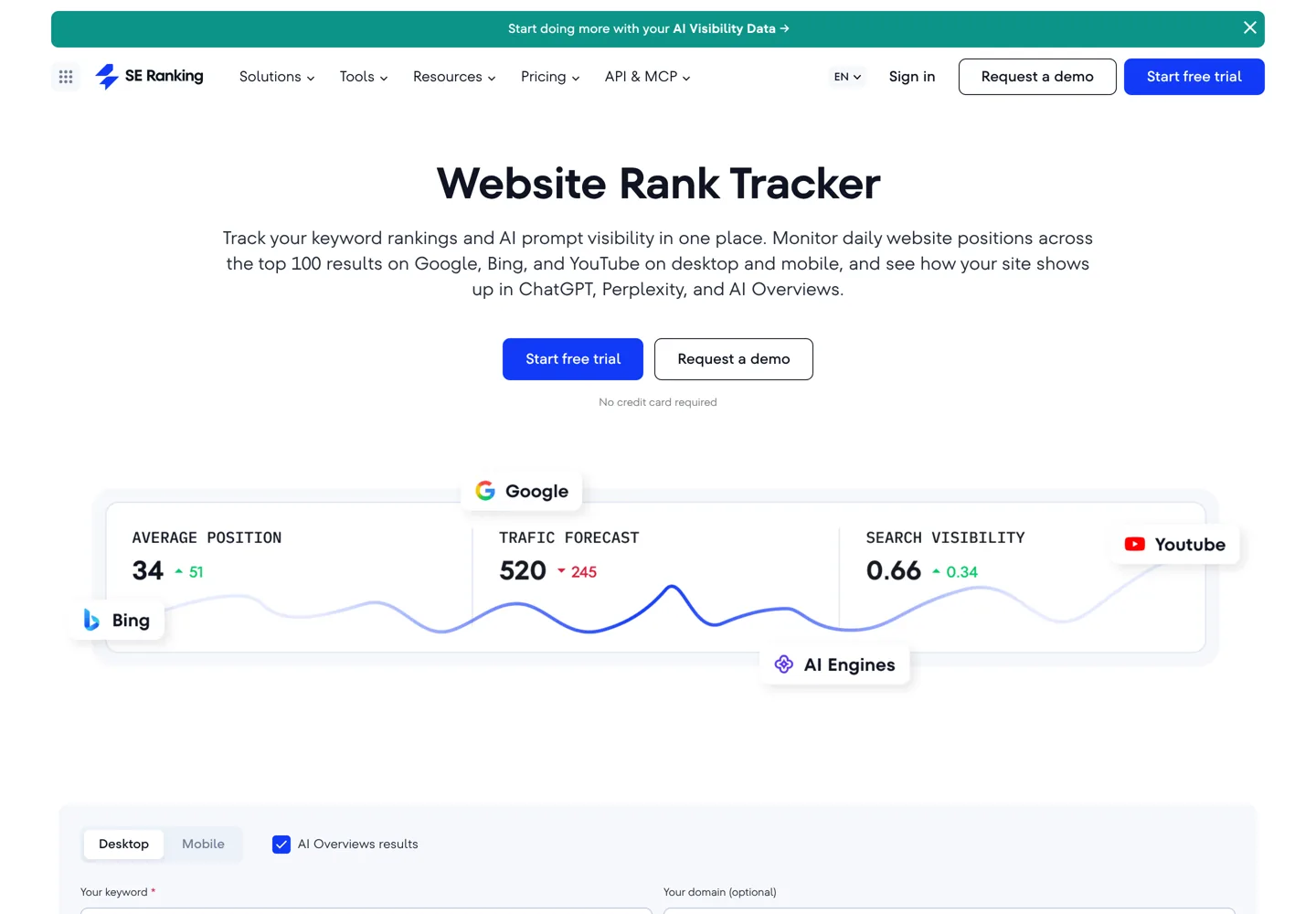
| SE Ranking | $129 ($103.20 yearly) | 2,000 | Daily | 14-day free trial |
| Semrush | $139 ($117.33 yearly) | 500 | Daily | 7-day free trial |
| Ahrefs | $129 (Lite) | 750 | Weekly by default | No trial |
| Wincher | $49 ($41 yearly) | 500 | Daily | Free to try |
| Nightwatch | €99 (€79 yearly) | 500 | Daily | 14-day free trial, no card |
| Mangools | $61 ($37.70 yearly) | 200 | Weekly (daily on Agency) | 48-hour money-back |
| Google Search Console | Free | Every query you appear for | Daily (average position) | Free |
What a rank tracker does (and doesn’t)
A rank tracker searches Google for your chosen keywords from a chosen location and device, records where your pages rank, and charts the changes over time. Good trackers also record SERP features (featured snippets, local packs, AI Overviews), track competitors on the same keywords, and alert you to drops.
Two things to know before you choose. First, rankings differ by location and device, so track the country or city where your readers are, on mobile if most of them use phones. Second, a tracker shows the position for one search at one moment; Google Search Console shows your average position across all real searches. Use both: Search Console for the full picture, a tracker for daily detail on your priority keywords.
The best rank tracking tools
1. AccuRanker: the fastest dedicated tracker
AccuRanker does one job: rank tracking. It updates every keyword daily and lets you refresh a keyword or a whole domain on demand every two hours. It tracks 45+ SERP features, AI Overviews (including whether your URLs are cited), Google, Bing and YouTube, and includes unlimited users on every plan. The Professional plan is $249 a month for 2,000 keywords ($224 billed yearly). There’s no free trial (AccuRanker offers a demo instead), but there is a 14-day refund window from your first purchase. Our AccuRanker review and AccuRanker vs Ahrefs comparison cover it in depth.
2. SE Ranking: the best value for daily tracking
SE Ranking gives you 2,000 keywords tracked daily for $129 a month ($103.20 billed yearly), plus unlimited keyword, competitor and backlink research and a site audit of 250,000 pages a month, across 10 projects. That works out at the lowest cost per tracked keyword of any tool here, and its 14-day free trial is fully functional. If you want one tool that tracks rankings well and handles the rest of your SEO, start here.
3. Semrush: tracking inside the biggest SEO suite
Semrush Position Tracking updates daily, follows up to 20 competitors, records SERP features including AI Overviews, and tracks by device and location. The catch is volume: the $139 SEO plan tracks 500 keywords, so you pay mostly for Semrush’s research tools. It’s the right choice if you already use Semrush for keyword research and competitor analysis; see our Semrush review.
4. Ahrefs: weekly tracking with deep link data
Ahrefs Rank Tracker covers 190+ locations down to city and ZIP code, compares up to 10 competitors and shows share of voice. Its default update frequency is weekly on every plan, which is fine for slower-moving sites but means you’ll see a drop up to a week late. The Lite plan is $129 a month with 750 tracked keywords. Choose Ahrefs for its backlink and research data, not for daily tracking.
5. Wincher: simple, affordable daily tracking
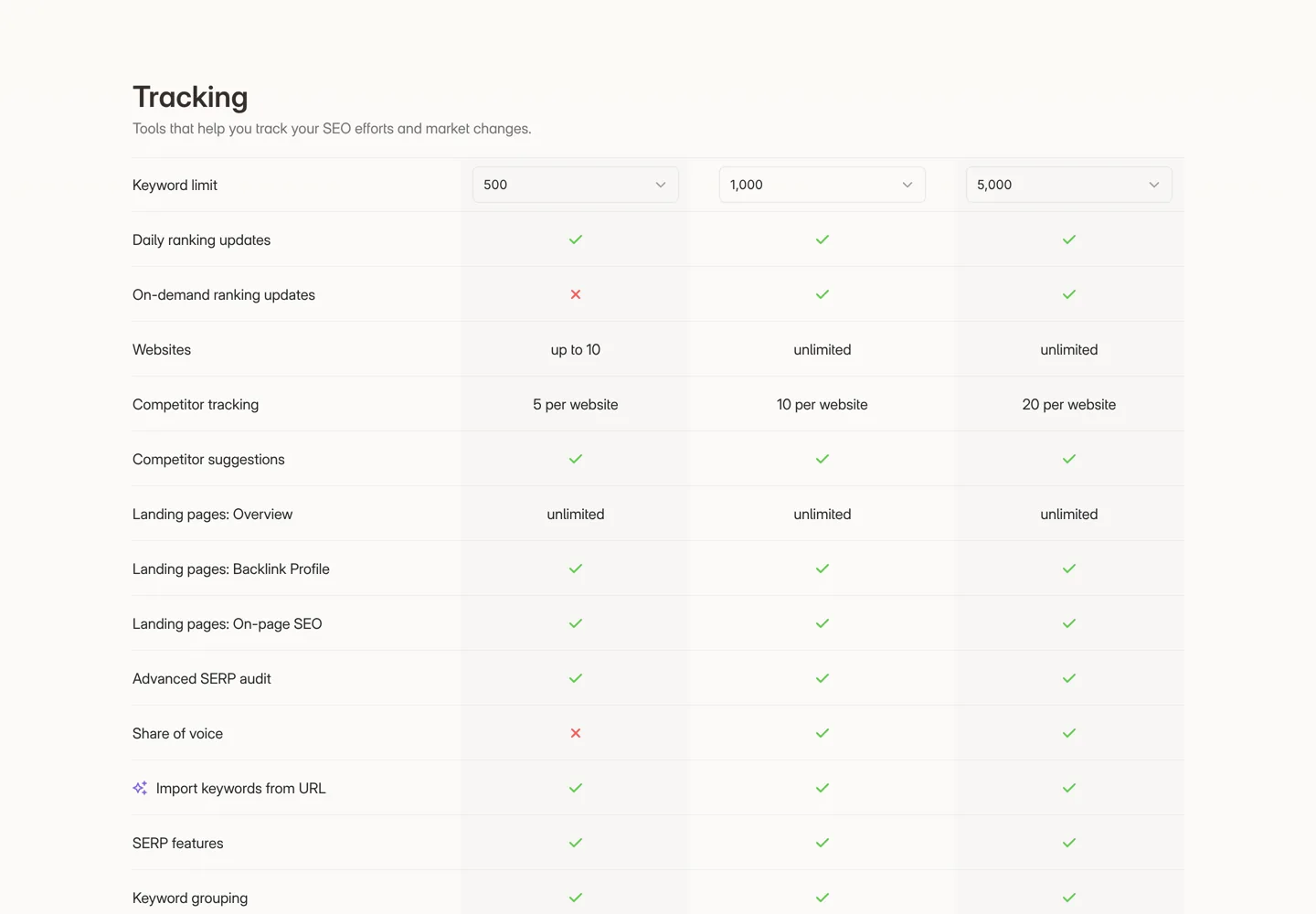
Wincher is built for small teams who want daily rankings without a full SEO suite. Basic is $49 a month ($41 billed yearly) for 500 keywords tracked daily across up to 10 websites; Standard ($89 a month) adds on-demand updates, 1,000 keywords and unlimited websites; Professional is $319 a month from 5,000 keywords. It also offers local rank tracking on Google Maps, and you can try it for free.
6. Nightwatch: daily tracking across search engines and AI
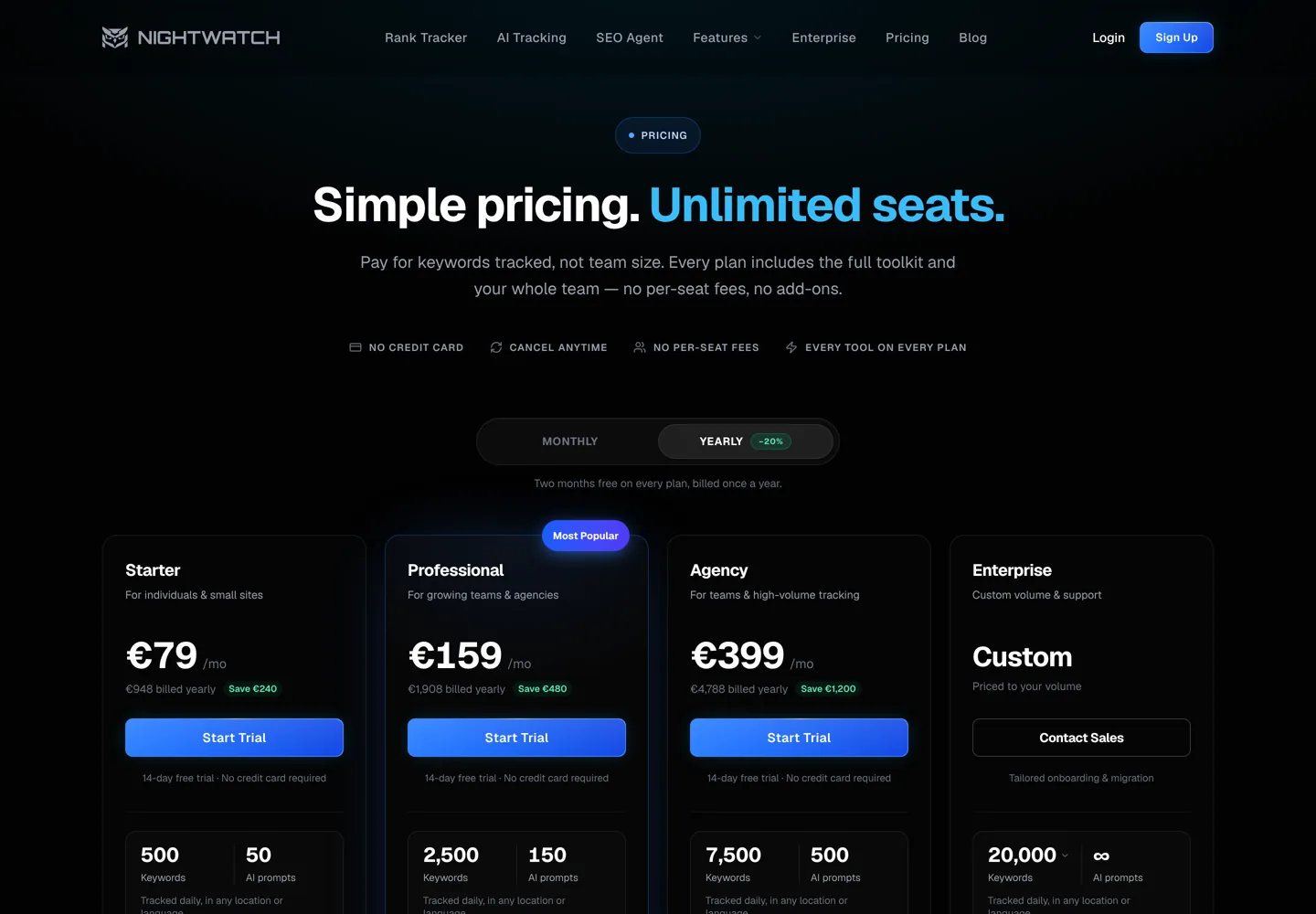
Nightwatch tracks Google, YouTube, Bing, Yahoo, DuckDuckGo and Google Maps, plus AI platforms such as ChatGPT, Claude, Gemini, Perplexity and Google’s AI Mode and AI Overviews. Every plan includes the full toolkit and unlimited team seats. Starter costs €99 a month, or €79 billed yearly, for 500 keywords tracked daily and 50 AI prompts; Professional is €199 (€159 yearly) for 2,500 keywords. There’s a 14-day free trial with no card.
7. Mangools: budget all-rounder with SERPWatcher
Mangools bundles its SERPWatcher rank tracker with KWFinder keyword research, SERP analysis, backlinks and AI search monitoring. Mangools Basic costs $61 a month ($37.70 billed yearly) for 200 keywords updated weekly; Premium is $81 ($52.70 yearly) for 700 keywords, also weekly; Agency is $141 ($97.70 yearly) for 1,500 keywords updated daily. It has a 48-hour money-back guarantee. It’s great value as a beginner’s research tool; for daily tracking you need the Agency plan.
8. Google Search Console: free and essential
Search Console is free and shows every query your site appears for, with clicks, impressions and average position, for the last 16 months. It isn’t a rank tracker in the strict sense (it averages positions across real searches rather than checking one keyword in one place), but it’s the most accurate picture of your real performance. Every site should use it, with or without a paid tracker. Our guide to free tools to check your blog traffic shows how to set it up.
Cost per keyword: the fairest comparison
Entry prices hide very different limits. Dividing each plan’s monthly price by its tracked keywords shows what you really pay for tracking:

SE Ranking, Mangools Agency and Wincher track daily for under $100 per 1,000 keywords a month. AccuRanker costs more but adds on-demand refreshes and unlimited users. Semrush and Ahrefs cost the most per tracked keyword because their price mainly pays for research tools.
Daily or weekly updates?

Daily tracking matters for news sites, online shops and anyone running an active SEO campaign, because you see the effect of changes the next day. Weekly tracking is enough for most small blogs that publish a few posts a month. Don’t pay for daily updates you won’t look at. If you’re unsure, start weekly or on a smaller daily plan, and upgrade once you find yourself checking rankings more often than the tool refreshes them.
How to choose a rank tracker
- Count your keywords. List the keywords that matter (your main posts’ focus keywords, plus a few competitors’ terms). Most blogs need 100 to 500.
- Decide daily or weekly. See above.
- Check locations and devices. Make sure the tool tracks your readers’ country or city, on mobile.
- Decide whether you need research too. If yes, SE Ranking, Semrush or Mangools; if you only need tracking, AccuRanker, Wincher or Nightwatch.
- Use the trial. SE Ranking and Nightwatch give 14 days free, Semrush 7, Wincher lets you try for free; AccuRanker has a 14-day refund and Mangools a 48-hour money-back guarantee.
Before you add keywords, make sure they’re the right ones: our guide to keyword research explains how to choose them, and the best keyword research tools compares research suites.
Set up rank tracking the right way
A tracker is only as useful as the keywords and settings you give it. Whichever tool you pick, set it up like this:
- Group keywords by page or topic. Use tags or groups so you can see how a whole topic moves, not just single keywords.
- Set the page you want to rank. Where the tool allows a target URL, add it, so you notice when Google ranks a different page of yours for the keyword (a sign that two posts compete).
- Add three to five real competitors. The sites you actually meet in the results, not the biggest brands in your niche.
- Turn on alerts for big drops, and ignore day-to-day moves of one or two positions; they’re normal.
- Review monthly alongside Search Console. If a keyword drops in the tracker but clicks in Search Console hold steady, it may be a location or device difference rather than a real loss.
Then act on what you see: refresh posts that slip from page one, and write new posts for keywords where competitors rank and you don’t.
Our picks
- Best value: SE Ranking, for 2,000 daily-tracked keywords at $129 a month with research included.
- Best dedicated tracker: AccuRanker, for speed, on-demand refreshes and unlimited users.
- Best on a small budget: Wincher Basic at $49 a month for 500 daily keywords.
- Best for search plus AI platforms: Nightwatch.
- Best free option: Google Search Console, which every site should use anyway.
Questions people ask
What is the best rank tracking tool?
SE Ranking is the best value, with 2,000 keywords tracked daily for $129 a month plus SEO research. AccuRanker is the best dedicated tracker for speed and on-demand updates. Wincher is the best low-cost option.
Is there a free rank tracker?
Google Search Console is free and shows the average position of every query your site appears for. Most paid trackers also offer free trials, such as SE Ranking and Nightwatch for 14 days.
How often should rankings update?
Daily if you run an active SEO campaign, a shop or a news site; weekly is enough for most small blogs. Ahrefs updates weekly by default, and AccuRanker also lets you refresh on demand every two hours.
Why do my rankings differ from what I see in Google?
Results vary by location, device and personalisation. Rank trackers check from a set location and device; Search Console averages positions across real searches. Track the location and device your readers use.
How many keywords should I track?
Most blogs need 100 to 500: the focus keyword of each important post plus a few competitor terms. Agencies tracking client sites need thousands.
Is Semrush or Ahrefs good for rank tracking?
Both track rankings well, but you pay mostly for their research tools: Semrush tracks 500 keywords daily on its $139 plan and Ahrefs 750 weekly on its $129 Lite plan. A dedicated tracker gives you more keywords for the money.
Sources
- AccuRanker pricing www.accuranker.com · checked October 11, 2026
- SE Ranking pricing seranking.com · checked October 11, 2026
- Semrush pricing www.semrush.com · checked October 11, 2026
- Ahrefs pricing ahrefs.com · checked October 11, 2026
- Wincher pricing www.wincher.com · checked October 11, 2026
- Nightwatch pricing nightwatch.io · checked October 11, 2026
- Mangools plans and pricing mangools.com · checked October 11, 2026
- Semrush rank tracking www.semrush.com · checked October 11, 2026

Building websites since 2006: 500+ web projects of every size and $300K+ in website deals sold or brokered. Founder of A Digital Motive and DigiFlippers. I share the whole process here, plainly.
Founder of A Digital Motive and DigiFlippers