Some links on this page are affiliate links. If you buy through them I may earn a commission, at no extra cost to you. It never changes a rating. Read the disclosure
- Fan funding and Shopping open at 500 subscribers with 3,000 watch hours or 3M Shorts views.
- Ad revenue needs 1,000 subscribers and 4,000 watch hours or 10M Shorts views today.
- From 1 Feb 2027, new channels need 8,000 watch hours or 20M Shorts views for ads.
- You keep 55% of long-form ad revenue, 45% of Shorts pool revenue and 70% from fans.
- Sponsorships and affiliate links work from your first video; tick the paid promotion box.
To make money on YouTube, you can earn from YouTube itself through the YouTube Partner Program (ads, YouTube Premium, channel memberships and Supers), and from outside YouTube through sponsorships, affiliate links and your own products. This guide explains each income stream, the exact thresholds to qualify and the revenue share YouTube pays, all taken from YouTube’s own Help Center on 12 October 2026, including the Partner Program changes that start on 1 February 2027.
This page is about YouTube income only. If you also run a blog, our guide to earning money from a blog covers the written side.

How YouTube pays creators
YouTube’s Partner Program (YPP) is the gateway to every income stream YouTube pays for. Once you’re in, you choose which features to turn on by accepting their “modules” in YouTube Studio. YouTube’s partner earnings page lists the standard revenue shares:
| Income | Your share | Module to accept |
|---|---|---|
| Ads on long-form videos (Watch Page) | 55% of net ad revenue | Watch Page Monetization Module |
| Ads in the Shorts Feed | 45% of your allocation from the Creator Pool | Shorts Monetization Module |
| Memberships, Super Chat, Super Stickers, Super Thanks | 70% of net revenue | Commerce Product Module |
Your exact rates are in your own agreements: YouTube Studio → Settings → Agreements.
YouTube is clear that there’s no guarantee about how much you’ll earn. Ad earnings depend on how many ads are shown and what advertisers pay, which varies by country, topic and season, so be wary of any article that promises a fixed amount per thousand views.
How to make money on YouTube with the Partner Program
The two entry levels
YPP has two levels of eligibility today. Fan funding and Shopping open earlier; ad revenue needs more:

- Fan funding and Shopping: 500 subscribers and 3 public uploads in the last 90 days, plus either 3,000 qualified watch hours in the last 12 months or 3 million qualified Shorts views in the last 90 days.
- Ad revenue: 1,000 subscribers plus either 4,000 qualified watch hours in the last 12 months or 10 million qualified Shorts views in the last 90 days. Watch hours from Shorts in the Shorts Feed don’t count towards the 4,000 hours.
You also need to follow YouTube’s channel monetization policies, live in a country where YPP is available, have no active Community Guidelines strikes, turn on 2-Step Verification for your Google Account, have advanced features access and link one AdSense for YouTube account. YouTube says it usually reviews applications in about a month; if you’re turned down, you can appeal within 21 days or reapply after 30 days.
What changes on 1 February 2027
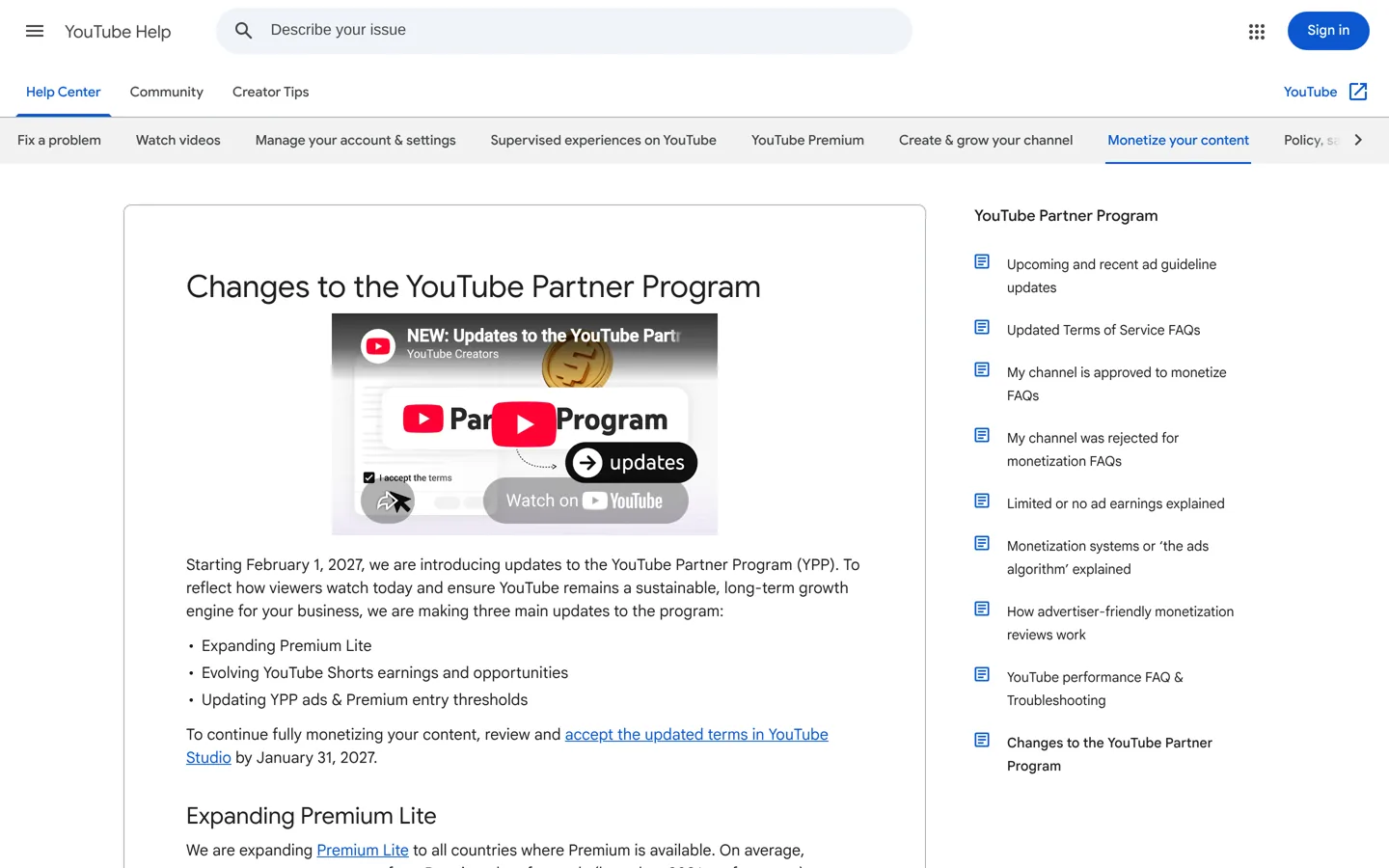
YouTube has announced three updates to YPP from 1 February 2027. Existing partners need to accept the updated terms in YouTube Studio by 31 January 2027 to keep monetizing fully.
- Higher entry for ad revenue (new channels only): 1,000 subscribers plus 8,000 qualified watch hours in the last 365 days, or 20 million qualified Shorts views in the last 90 days. Channels already in YPP aren’t affected. The 500-subscriber level for fan funding, Shopping and YouTube Creator Partnerships doesn’t change.
- A monthly bar for Shorts earnings: to earn from the Shorts Creator Pool in a given month, you’ll need 10 million qualified Shorts views over the last 90 days. Missing it doesn’t remove you from YPP or affect long-form earnings.
- Premium Lite everywhere Premium is offered: creators share a pool of 60% of net Premium Lite subscription revenue, and 30% for Premium views. YouTube says creators earn more per user from Premium than from ads on average.
YouTube also describes new Shorts incentive programmes and a direct 45% share on Shorts ads targeted at five or fewer channels.
Staying in the Partner Program
Getting in is only the first step: YouTube says it keeps reviewing channels in YPP to make sure they still follow its policies. From 1 February 2027 it also updates what counts as an active channel. You’ll stay active if you have any one of these: 1,000 qualified watch hours in the past 365 days, 1 million qualified Shorts views in the last 90 days, or 2 long-form videos or 5 Shorts uploaded every 90 days. Channels that drop below get a 90-day window to get back above one of these bars.
The policy that trips up most channels is originality. YouTube’s monetization policies expect content to be your own and “authentic”. In July 2025 YouTube renamed its “repetitious content” policy to “inauthentic content” to make clear that repetitive or mass-produced videos aren’t eligible. Commentary, clips, compilations and reaction videos are judged under the separate reused content policy, so add real value of your own to anything that uses other people’s material.
Ad revenue: long-form videos and Shorts
Long-form videos earn from ads shown on the Watch Page, and the same 55% share applies when your videos play in YouTube’s player embedded on other websites. Every video must follow YouTube’s advertiser-friendly content guidelines to earn full ad revenue.
Shorts work differently. Ad revenue from the Shorts Feed is pooled each month. Revenue linked to Shorts that use music is partly set aside for music licensing: with one track, half goes to the Creator Pool; with two, a third. The Creator Pool is then shared among monetizing creators by their share of engaged views in each country, and you keep 45% of your allocation whether or not you used music. Non-original Shorts, such as unedited clips or reuploads, don’t count.
Fan funding: memberships and Supers
- Channel memberships: viewers pay monthly for perks such as badges, emoji or members-only videos.
- Super Chat and Super Stickers: viewers pay to highlight a message or animated sticker in your live chat.
- Super Thanks: viewers pay to highlight a comment on a video or Short.
You must be at least 18 and accept the Commerce Product Module. Memberships aren’t available for channels set as made for kids. YouTube pays 70% of net revenue from all four features.
YouTube Shopping
With Shopping, viewers can browse and buy from your own store on YouTube, or from other brands’ products you tag through the YouTube Shopping affiliate programme. It needs the same 500-subscriber level as fan funding, and it isn’t available to music channels, Official Artist Channels or channels set as made for kids.
Ways to earn outside YouTube

These don’t need YPP, so you can start with your first video:
- Sponsorships. Brands pay you to feature their product. If you do, YouTube requires you to tick the paid promotion box in the video’s details, which adds a disclosure label at the start of the video. YouTube’s own Creator Partnerships programme connects brands with eligible creators.
- Affiliate links. Recommend tools or products in your videos and add tracked links to the description. Programmes such as Amazon Associates pay a commission on sales; our list of recurring affiliate programmes pays you every month a customer stays. For viewers in different countries, geni.us links send each viewer to their local Amazon store.
- Your own products and services. Courses, ebooks, templates, coaching or consulting. Your videos show your expertise; your own product keeps most of the money.
- Licensing. Media companies sometimes pay to use popular or newsworthy clips. Keep your original files and be clear about who owns what.
A plan to start earning
- Choose a topic people search for and that you can cover for years. Tutorials and reviews work well with affiliate links from the start.
- Research titles before you film. YouTube Studio‘s research tools, vidIQ or TubeBuddy show what people search for; our guide to YouTube rank checker tools shows where your videos rank.
- Add affiliate links and a simple offer from your first video, with a clear disclosure.
- Publish regularly. The 500-subscriber level needs 3 public uploads in 90 days, and from 2027 staying active in YPP counts uploads or watch time.
- Track your progress in YouTube Studio’s Earn section and turn on “Get notified” to hear when you’re eligible.
- Apply, then switch on each module you want: Watch Page ads, Shorts ads, fan funding and Shopping.
Getting paid
YouTube pays through AdSense for YouTube, and each payments account has its own thresholds. For accounts in US dollars, AdSense’s help page lists a $100 payment threshold, with identity and address verification at $10. YouTube’s Help Center notes that you may be liable to pay tax on your YouTube earnings, so keep records from the start and check the rules where you live.
Mistakes that cost creators money
- Reused or mass-produced content. YouTube’s monetization policies reward original, “authentic” content; channels of reused clips or repetitive, mass-produced videos aren’t eligible.
- Hiding sponsorships. Skip the paid promotion box and you break YouTube’s rules as well as many countries’ advertising laws.
- Relying on one income stream. Ad rates rise and fall, and Shorts earnings from 2027 depend on a monthly view bar. Affiliate links and your own products steady your income.
- Ignoring advertiser-friendly guidelines. Videos that don’t meet them earn limited or no ad revenue.
Tools that help
Good audio matters more than an expensive camera. Many creators record with OBS Studio (free) or Riverside for interviews, edit with CapCut or Descript, and design thumbnails in Canva. Social Blade shows public channel statistics if you want to compare your growth with similar channels.
Questions people ask
How many subscribers do you need to make money on YouTube?
500 for fan funding and Shopping (with 3,000 watch hours or 3 million Shorts views), and 1,000 for ad revenue (with 4,000 watch hours or 10 million Shorts views). Sponsors and affiliate links need none.
How much does YouTube pay per view?
There's no fixed rate. YouTube pays 55% of net ad revenue on long-form videos, but ad revenue varies by country, topic and season, and YouTube guarantees no amount.
Can you make money from YouTube Shorts?
Yes. Partners who accept the Shorts Monetization Module keep 45% of their share of the Shorts Creator Pool. From 1 February 2027, you'll need 10 million qualified Shorts views in 90 days to earn from the pool each month.
What is changing in the YouTube Partner Program in 2027?
From 1 February 2027, new channels need 8,000 watch hours or 20 million Shorts views (plus 1,000 subscribers) for ad revenue, Shorts pool earnings need 10 million views in 90 days, and Premium Lite expands.
How does YouTube pay creators?
Through AdSense for YouTube. For US-dollar accounts, AdSense lists a $100 payment threshold.
Do I have to disclose sponsorships on YouTube?
Yes. YouTube requires you to select the paid promotion button in the video details, which adds a disclosure label at the start of the video.
Sources
- YouTube Partner Program overview & eligibility support.google.com · checked October 12, 2026
- How to earn money on YouTube support.google.com · checked October 12, 2026
- Changes to the YouTube Partner Program support.google.com · checked October 12, 2026
- YouTube partner earnings overview support.google.com · checked October 12, 2026
- YouTube Shorts monetization policies support.google.com · checked October 12, 2026
- YouTube channel monetization policies support.google.com · checked October 12, 2026
- Paid product placements and endorsements (YouTube Help) support.google.com · checked October 12, 2026
- AdSense payment thresholds support.google.com · checked October 12, 2026

Building websites since 2006: 500+ web projects of every size and $300K+ in website deals sold or brokered. Founder of A Digital Motive and DigiFlippers. I share the whole process here, plainly.
Founder of A Digital Motive and DigiFlippers