- BuiltWith lookups are free; its paid plans ($295 to $995 a month) are for lead lists.
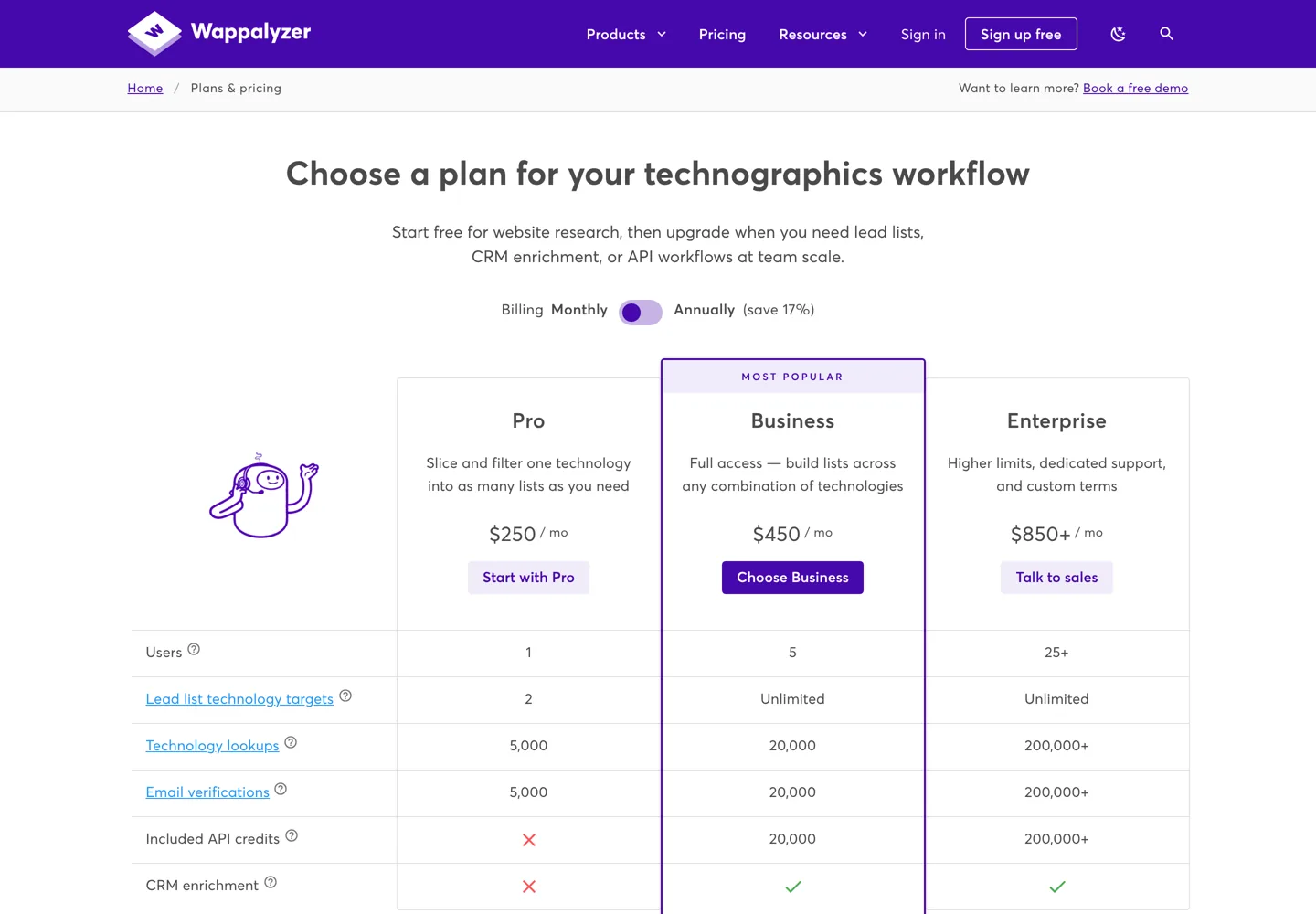
- Wappalyzer's free account includes 50 lookups a month; Pro is $250 a month.
- WhatRuns is a free extension with no sign-up and no paid plan.
- W3Techs shows market shares: WordPress runs 40.1% of all websites.
- Datanyze, SimilarTech and Ghostery are no longer technology profilers in the same way.
The best BuiltWith alternatives depend on why you’re looking. If you just want to know what a website is built with (its CMS, theme, plugins, analytics or hosting), free tools such as Wappalyzer, WhatRuns, W3Techs, What CMS and Netcraft do the job, often from a browser extension. If you need what BuiltWith is really sold for, lists of every site using a technology for sales and market research, the paid alternatives are Wappalyzer’s lead lists and NerdyData’s source code search.
This guide explains what BuiltWith does and costs, then compares each alternative on what it shows, its free limits and its price, all from the tools’ own websites, checked on the date at the end.
BuiltWith alternatives compared
| Tool | Best for | Free | Paid from |
|---|---|---|---|
| BuiltWith | Technology lead lists and trends | Single site lookups, browser extension | $295 a month |
| Wappalyzer | Quick lookups and lead lists | 50 lookups a month, browser extension | $250 a month |
| WhatRuns | A free browser extension | Free, no sign-up | No paid plan |
| W3Techs | Market share of technologies | Site lookups and surveys | Reports and API |
| NerdyData | Searching the web’s source code | Free account (100 rows per report), result counts before you pay | $200 a month |
| What CMS | Detecting the CMS | Lookups; free API with 500 detections | Paid API and batches |
| Netcraft | Hosting and server details | Free Site Report | Security services |
Prices in US dollars on monthly billing, from each tool’s website when this guide was updated.

What BuiltWith does and what it costs
BuiltWith looks up the technologies a website uses and, more importantly for its paying customers, builds lists of every site using a given technology. Its plans page says it has data from 491.9 million domains and tracks 127,768 web technologies, with more than 18 years of trend history.
Single site lookups are free forever, and BuiltWith has browser extensions for Chrome, Firefox and Edge. The paid plans are for lists and exports:
| Plan | Price | Includes |
|---|---|---|
| Basic | $295 a month | 2 technologies, 2 keywords, 2 retail reports, 1 login, CRM integration |
| Pro | $495 a month | Unlimited technologies, keywords and reports, 1 login |
| Team | $995 a month | Unlimited, with unlimited Pro logins |
BuiltWith also offers a discounted yearly price and says all plans can be cancelled at any time. For most bloggers and freelancers, that’s more than they need, which is why people look for alternatives.
1. Wappalyzer
Wappalyzer is the closest all-round alternative. Its browser extension, for Chrome, Firefox, Edge and Safari, shows the technology behind any site you visit with one click, and the website adds lookups, lead lists, CRM enrichment and an API.
- Free account: 50 technology lookups and email verifications a month, 5 website alerts and sample lead lists.
- Pro: $250 a month, or $2,500 a year: 1 user, 2 lead-list technology targets, 5,000 lookups and 5,000 email verifications.
- Business: $450 a month: 5 users, unlimited technology targets and 20,000 lookups, verifications and API credits.
- Enterprise: from $850 a month, with higher limits.
Annual billing saves 17%. You can pause a plan for up to three months or cancel at any time; included API credits expire after 60 days.
2. WhatRuns
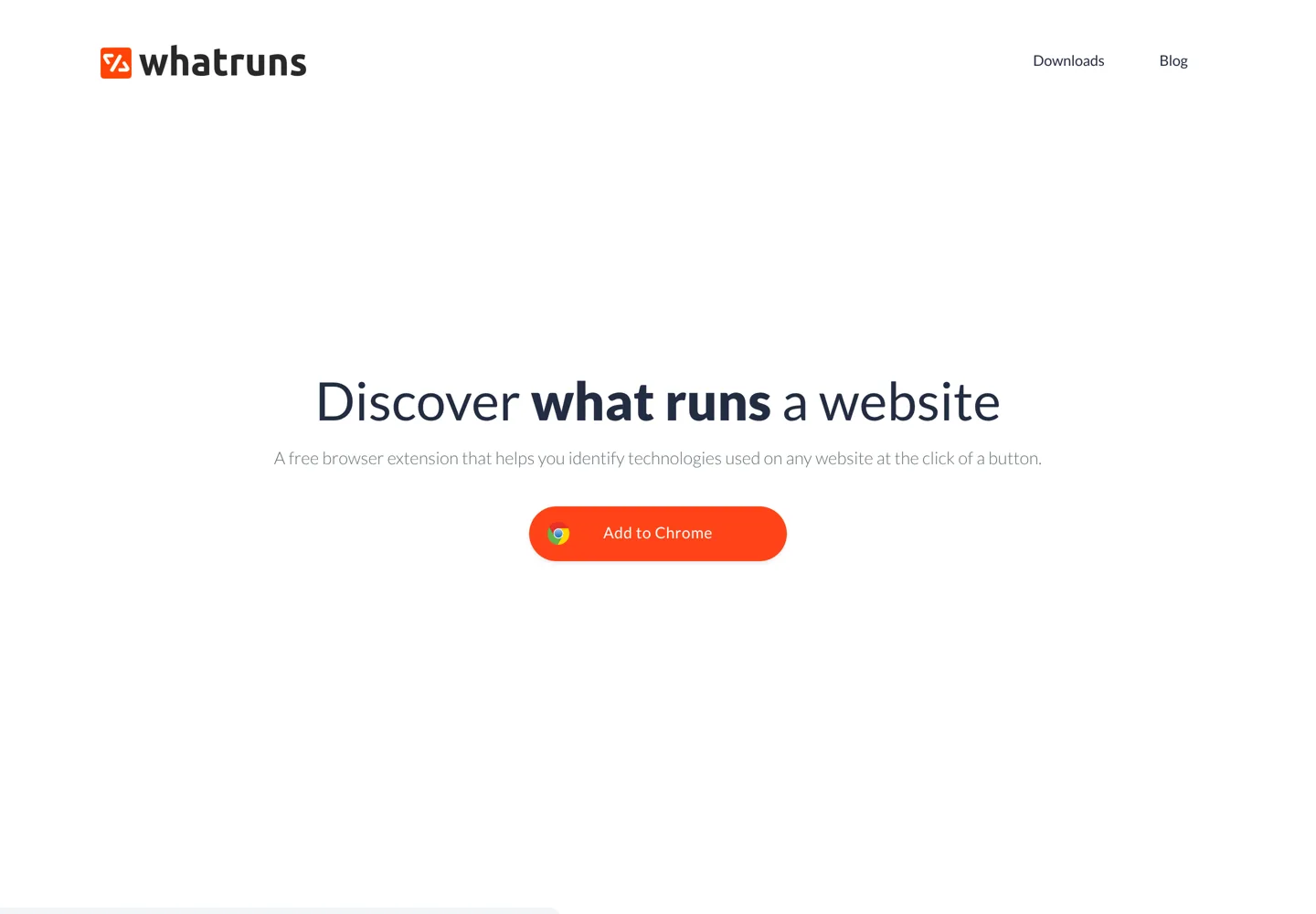
WhatRuns is a free browser extension that shows what powers a website at the click of a button: web apps, the CDN, analytics, WordPress plugins and fonts. No sign-up is needed. You can also follow a website and get notified when it starts or stops using a technology, which is handy for keeping an eye on competitors. WhatRuns says it has more than 450,000 active users.
It doesn’t build lead lists or export data, so it’s a lookup tool, not a replacement for BuiltWith’s paid plans.
3. W3Techs
W3Techs answers a different question: how popular is a technology across the web? Its surveys show market shares for content management systems, programming languages, servers and more. When this guide was updated, W3Techs reported WordPress on 40.1% of all websites and 58.6% of sites that use a known CMS, with Shopify, Wix and Squarespace next.
Its free Site Info lookup also shows the technologies a single site uses, from the CMS and its version to JavaScript libraries. W3Techs sells reports and a site info API for heavier use.

4. NerdyData
NerdyData searches the source code of websites, so you can find sites using a technology, a tracking code or even a specific snippet that other tools don’t recognise: any HTML, JavaScript, CSS, HTTP header or cookie. A free account unlocks up to 100 rows per report, and you can build a report and see the total number of results before you pay. Paid plans are Basic at $200 a month (5,000 rows per download, 1,000 domain enrichments a month) and Pro at $300 (200,000 rows, 5,000 domains), with Enterprise priced on request and a yearly option. API access is pay-as-you-go and not included in the subscription, and its browser extension and Gmail add-on are free.
5. What CMS
What CMS started by telling you which content management system a website runs on, and now detects 1,540 website technologies, from e-commerce platforms to frameworks and programming languages. Lookups on its website are free, and its free API plan includes 500 detections a month at one URL every 10 seconds. Paid plans add batch detection of many addresses, technology reports, and hosting provider and WordPress theme detection (through its sister site ThemeDetect.com).
6. Netcraft
Netcraft is best known for internet security, but its free Site Report finds the infrastructure and technologies used by any site, built on Netcraft’s own internet data mining. Reports show details such as the hosting company, hosting country, IP address and network. Use it when you want to know where a site is hosted rather than which plugins it uses.
What about Datanyze, SimilarTech and Ghostery?
Older lists of BuiltWith alternatives, including the earlier version of this page, named these three. They’ve changed since:
- Datanyze is better known today for sales prospecting data than for technology profiling; its site didn’t load for us, so check what it offers before you choose it.
- SimilarTech didn’t load for us either. For traffic and market data, Similarweb is the better-known option. For traffic estimates, see the free blog traffic checkers.
- Ghostery is a privacy tool that blocks ads and trackers. It shows which trackers a page loads, but it isn’t built to profile a site’s technology.
How to choose a BuiltWith alternative
- “What is this site built with?” Install the free Wappalyzer or WhatRuns extension; use What CMS for the CMS alone and Netcraft for hosting.
- “How popular is this technology?” W3Techs surveys.
- “Give me a list of sites using X.” Wappalyzer Pro or Business, NerdyData or BuiltWith itself.
- “Find sites with this exact code.” NerdyData’s source code search.
Start free. Try a lookup extension for a week; only if you find yourself copying site after site into a spreadsheet do you need a paid lead-list plan, and then a monthly plan lets you test whether the lists bring in work before you commit to a year.

Find what a website is built with for free, without any tool
You can often spot the basics yourself. In your browser, open the page source (View page source, or Ctrl+U on Windows and Cmd+Option+U on a Mac) and search for clues:
- wp-content in image or script addresses means WordPress, and the folder after /themes/ is usually the theme’s name.
- cdn.shopify.com means Shopify.
- A generator meta tag often names the CMS and sometimes its version.
- Tracking codes such as gtag or googletagmanager.com show which analytics a site uses.
Tools do this faster and recognise thousands of technologies, but checking the source is a good way to confirm what an extension tells you.
Before you install a browser extension
Technology-lookup extensions work by reading the pages you visit, so they usually ask for permission to access data on all websites. That’s normal for this kind of tool, but install only from the official Chrome, Firefox, Edge or Safari stores, read what each one says it collects in its privacy policy, and remove extensions you no longer use. One or two well-known lookup extensions are plenty; running several at once just slows your browser down without telling you much more.
If you only need a lookup now and then, you can skip the extension entirely: BuiltWith, W3Techs and What CMS all let you type an address into their website and see the results there.
Accuracy: why tools sometimes disagree
Every one of these tools detects technologies from what a website reveals, such as file paths, code patterns, headers and cookies. That means they can miss things that run only on the server, show technology from a single page rather than the whole site, or be fooled by sites that hide or fake those signs. BuiltWith itself warns that some profiles are misleading for that reason. If a decision matters, check with two tools and the page source.
Who uses these tools
- Bloggers and site owners look up the theme and plugins behind a site they admire. If it’s WordPress, see the guides to the best WordPress themes and the best WordPress plugins.
- Website buyers check a site’s platform and hosting before making an offer; see how to flip websites.
- Freelancers and agencies find businesses using an old platform that may need a rebuild.
- Developers compare platforms; the guide to WordPress and other CMS explains the main options.
Questions people ask
Is there a free alternative to BuiltWith?
Yes. WhatRuns is a free browser extension, Wappalyzer has a free account with 50 lookups a month and a browser extension, and W3Techs, What CMS and Netcraft offer free lookups on their websites. BuiltWith's own single-site lookups are free too.
Is BuiltWith free?
BuiltWith says single site lookups are free forever. Its paid plans, from $295 a month, are for building lists of websites that use a technology, with exports and CRM integration.
Is Wappalyzer better than BuiltWith?
For quick lookups, Wappalyzer's extension is easier and free. For lead lists, both are paid: Wappalyzer Pro is $250 a month and BuiltWith Basic is $295. Compare the limits of each plan for your use.
How can I find out what a website is built with?
Install a free extension such as Wappalyzer or WhatRuns, or type the address into BuiltWith, W3Techs or What CMS. You can also open the page source and look for clues such as wp-content for WordPress.
How do I find which WordPress theme a site uses?
Open the page source and look for /wp-content/themes/ followed by the theme's folder name, or use a lookup tool. Child themes or renamed folders can hide the original theme.
Are these tools always accurate?
No. They detect technologies from what a site reveals, so they can miss server-side software or be misled by sites that hide those signs. Check with two tools if the answer matters.
Sources
- BuiltWith plans and pricing builtwith.com · checked October 11, 2026
- BuiltWith browser extensions builtwith.com · checked October 11, 2026
- Wappalyzer pricing www.wappalyzer.com · checked October 11, 2026
- Wappalyzer apps www.wappalyzer.com · checked October 11, 2026
- WhatRuns www.whatruns.com · checked October 11, 2026
- W3Techs web technology surveys w3techs.com · checked October 11, 2026
- NerdyData pricing www.nerdydata.com · checked October 11, 2026
- What CMS whatcms.org · checked October 11, 2026
- Netcraft Site Report sitereport.netcraft.com · checked October 11, 2026

Building websites since 2006: 500+ web projects of every size and $300K+ in website deals sold or brokered. Founder of A Digital Motive and DigiFlippers. I share the whole process here, plainly.
Founder of A Digital Motive and DigiFlippers