- Blogger backups now come through Google Takeout as a feed.atom file.
- The Blogger Importer moves posts, comments, labels and images, but not pages or widgets.
- The importer was last updated in October 2024 and is rated 3.1 out of 5: check your post count.
- Blogs on their own domain can use real 301 redirects; blogspot.com blogs can't.
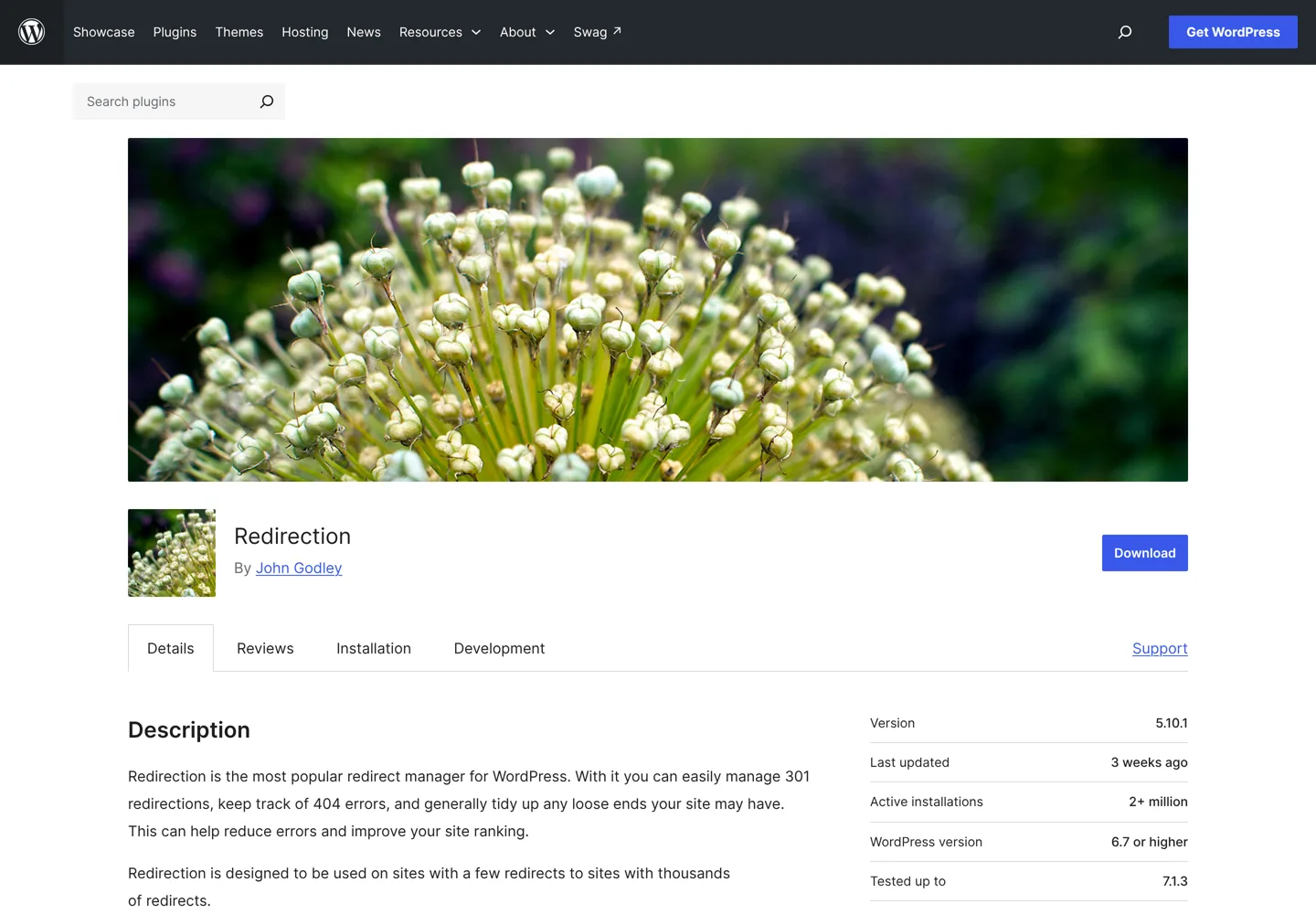
- Redirection's 404 log shows any old addresses you still need to redirect.
To migrate Blogger to WordPress, you back up your Blogger content, set up WordPress on your own hosting, import your posts and comments, move your images and pages, and then make sure every old post address still leads to the same post. That last step decides whether you keep your search traffic. This guide covers each step using Google’s own Blogger help and the official Blogger Importer plugin’s documentation, checked on 12 October 2026, including what the importer doesn’t move and how to handle redirects.
Still deciding whether to switch? Our Blogger vs WordPress comparison covers that. This page is the move itself.

Before you migrate Blogger to WordPress
First, check one thing: where does your blog live now? It makes the biggest difference to how much traffic you keep.

- On your own domain (such as yourblog.com, connected to Blogger): you’re in the best position. You’ll point the domain at your new host, and WordPress can send every old address to the right post with a permanent (301) redirect.
- On a blogspot.com address: Google controls that address, so you can’t run server-side redirects to another website from it. The available workarounds, covered below, are weaker than a real 301, so expect to lose some search traffic for a while.
Then gather what you’ll need:
- Web hosting and a domain. If you need hosting, our guide to what WordPress hosting is explains the types, and the best WordPress hosting ranking compares hosts.
- A fresh WordPress install on that hosting: see how to install WordPress.
- A list of your Blogger addresses. Save your blog’s sitemap (yourblog.blogspot.com/sitemap.xml, or the same path on your domain) so you can check every old address later.
Step 1: Back up your Blogger blog
Google’s Blogger help gives the current steps. Sign in to Blogger, choose your blog, open Settings, and under “Manage blog” click Back up content, then Download. Blogger now delivers the backup through Google Takeout, and the file containing your posts, pages and comments is called feed.atom. Google notes that Blogger’s older backups were .xml files and that both work the same way for importing into Blogger.
Save your theme too: in Blogger, open Theme, click the down arrow next to Customize, choose Backup and download it. You won’t use it in WordPress, but it keeps a record of your design, widgets and any code you added, such as analytics or ad snippets.
Keep the Blogger blog online for now. Don’t delete it: you’ll need it for the redirects.
Step 2: Set up WordPress
Install WordPress on your new hosting. If your blog uses its own domain, you can set up WordPress on the host first (most hosts give you a temporary address or let you preview the site) and switch the domain over at the end, so readers never see a half-finished site.
Before importing, go to Settings → Permalinks and choose your address format. Blogger’s post addresses look like /2024/05/post-title.html. WordPress lets you use a custom structure of /%year%/%monthnum%/%postname%.html, which matches that pattern and makes redirects much simpler. If you prefer cleaner addresses, such as /post-title/, that’s fine too; you’ll just need a redirect rule for the old pattern (see step 5).
Step 3: Import your posts with the Blogger Importer
WordPress’s official importer for Blogger is the Blogger Importer plugin, listed under Tools → Import. Click Install Now under Blogger, then Run Importer, and upload your backup file. The plugin reads the posts and lets you map Blogger authors to WordPress users. Its documentation recommends disabling all other plugins and caching during the import, and says that if an import fails halfway you can simply run it again: posts already imported are skipped, not duplicated.
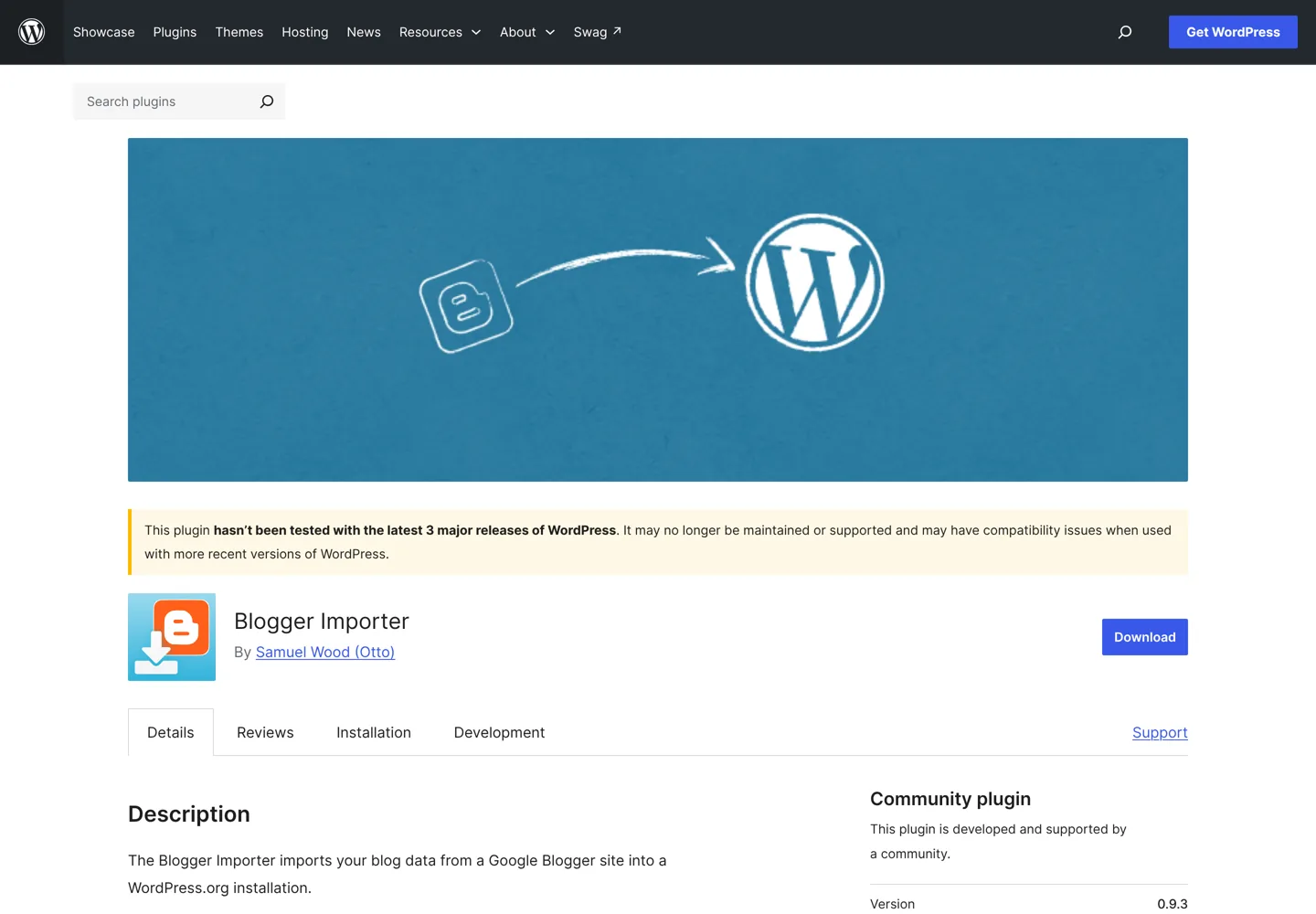
According to the plugin’s own page, it imports:
- categories (Blogger labels become WordPress categories);
- posts, whether published, scheduled or drafts;
- comments (not spam);
- images (by default it downloads a large version, up to 1,024 pixels wide).
It does not import pages, widgets, your template or theme, or comment and author avatars.
Be aware of the importer’s state before you rely on it. On WordPress.org (checked 12 October 2026) it has 50,000+ active installations but was last updated in October 2024 and has been tested only up to WordPress 6.6, while the current version is 7.1.3. WordPress.org now shows a notice on its page that it “hasn’t been tested with the latest 3 major releases of WordPress” and may no longer be maintained. Its rating is 3.1 out of 5 from 57 reviews, and recent reviews report incomplete imports and imports that stop on larger blogs. Its instructions also still describe Blogger’s older export; we haven’t tested it with Takeout’s feed.atom file. So import into a fresh site, check the post count afterwards, and keep your backup.
Step 4: Move images, pages and categories
Images. The importer tries to copy images to your WordPress media library. Any that stay on Google’s servers will keep working for now but aren’t under your control. The free Auto Upload Images plugin (20,000+ installs, updated September 2026 and tested with WordPress 7.1.3) finds external image addresses in a post when you save it, uploads them to your media library and replaces the addresses.
Pages. Blogger pages such as About and Contact aren’t imported, so recreate them in WordPress. Blogger page addresses look like /p/about.html; note each one for your redirects.
Categories and tags. Blogger doesn’t distinguish between tags and categories, so the importer turns every label into a category. The plugin’s documentation suggests reviewing them afterwards and using WordPress’s categories-to-tags converter (under Tools → Import) to turn minor labels into tags.
Step 5: Keep your old links working
This is the step that protects your search rankings and the links other sites have given you. The plugin’s documentation is clear that WordPress and Blogger handle permalinks differently, so addresses won’t match automatically. It suggests the Redirection plugin or your .htaccess file to map old addresses to new ones.
If your blog uses its own domain
- In Blogger, remove the custom domain (Settings → Publishing), so Blogger stops answering for it.
- At your domain registrar, point the domain’s DNS records to your new host, as your host’s instructions describe.
- Once the domain loads WordPress, test your old post addresses. If you used the
/%year%/%monthnum%/%postname%.htmlstructure and the slugs match, most will already work. - For anything that doesn’t, add 301 redirects in Redirection (2,000,000+ installs, free, with regular-expression support): one rule can send the old
/YYYY/MM/post.htmlpattern to your new format, and single rules handle pages (/p/about.htmlto/about/) and labels (/search/label/Nameto the category). - Watch Redirection’s 404 log for a few weeks and add a redirect for anything visitors still hit.
Check post slugs carefully: Blogger often shortens slugs, while WordPress builds them from the full title. Where they differ, edit the WordPress slug to match the old one, or add a redirect.
If your blog is on blogspot.com
Because you can’t put server-side 301 redirects on a blogspot.com address, the usual approach is a plugin such as Blogger To WordPress by rtCamp (3,000+ installs). It redirects visitors from each old Blogger post to the same post on WordPress, one to one, using rel=canonical and meta-refresh tags on the Blogger side, according to its description. Search engines treat these as weaker signals than a real 301, so plan for a dip in traffic and rebuild rankings with fresh internal links. If you’re moving off blogspot.com anyway, it’s worth buying a domain now so your next move, if there ever is one, can keep every link.
Step 6: Check the site and tell Google

- Compare post counts between Blogger’s dashboard and WordPress’s Posts screen.
- Open a sample of old addresses from your saved sitemap and confirm each one lands on the right post.
- Fix internal links: links inside your posts may still point to your blogspot.com address. Update them so they don’t bounce through redirects.
- Add your site to Google Search Console and submit your WordPress sitemap.
- Move your extras: analytics, AdSense and any other code from your Blogger theme; our best WordPress plugins list covers SEO, backups and more.
- Set up basic SEO with our WordPress SEO tutorial.
Common problems when you migrate Blogger to WordPress
- The import stops partway: run it again; the importer skips posts it has already imported. Disable other plugins and caching first, as its documentation advises.
- Some content is stripped out of posts: the importer cleans incoming content to remove potentially malicious code, and its documentation notes that a missing php-xml module on the server can cause text to be lost. Ask your host to check that it’s installed.
- Too many categories: convert minor ones to tags with the categories-to-tags converter.
- Old addresses show 404 errors: add redirects for them in Redirection and watch its 404 log.
- Drafts lost their planned dates: the importer’s documentation notes that WordPress doesn’t support dates on draft posts; scheduled posts transfer and publish as planned.
How long the move takes
For a small blog with its own domain, you can usually back up, import and redirect in an afternoon. Allow for DNS changes, which can take a few hours or more to reach everyone, and for checking each important post. Larger blogs, or blogs where the importer struggles, take longer; the work is mostly in checking images and redirects, not the import itself.
Once you’re settled, our WordPress guide for beginners covers the next steps, from themes to plugins.
Questions people ask
Can I move my Blogger blog to WordPress for free?
The tools are free: Blogger's backup, the Blogger Importer and Redirection plugins. You pay only for WordPress hosting and a domain if you don't have them.
Will I lose my Google rankings if I move from Blogger?
Not if your blog uses its own domain and every old address 301-redirects to the same post. Blogs on blogspot.com can't use real 301s, so expect some loss.
Does the Blogger Importer move pages?
No. It imports posts, comments, labels (as categories) and images, but not pages, widgets, your theme or avatars. Recreate pages by hand.
How do I export my Blogger blog?
In Blogger, open Settings and, under Manage blog, click Back up content, then Download. The backup comes through Google Takeout as a feed.atom file.
Can I keep my Blogger addresses in WordPress?
Largely. A custom permalink structure of /%year%/%monthnum%/%postname%.html matches Blogger's pattern; fix any slugs that differ or redirect them.
What if the Blogger Importer fails?
Run it again: it skips posts already imported. Disable other plugins and caching first. For large blogs, consider your host's migration service.
Sources
- Back up or import your blog (Blogger Help) support.google.com · checked October 12, 2026
- Blogger Importer (WordPress.org) wordpress.org · checked October 12, 2026
- Redirection (WordPress.org) wordpress.org · checked October 12, 2026
- Auto Upload Images (WordPress.org) wordpress.org · checked October 12, 2026
- Blogger To WordPress by rtCamp (WordPress.org) wordpress.org · checked October 12, 2026
- How to do a 301 redirect in Blogger (Blogger Community guide) support.google.com · checked October 12, 2026

Building websites since 2006: 500+ web projects of every size and $300K+ in website deals sold or brokered. Founder of A Digital Motive and DigiFlippers. I share the whole process here, plainly.
Founder of A Digital Motive and DigiFlippers