- Start with one problem for one specific group of people.
- Test demand with a small paid offer before building much.
- UK sole traders must register for Self Assessment over £1,000 a year.
- The SBA's launch steps include a business bank account.
- Find your first ten customers personally, then grow what works.
Here’s how to start an online business with little money: pick one problem you can solve for a specific group of people, choose a model (content, services, digital products or a shop), test demand before you build much, write a one-page plan, set up the legal and tax basics for your country, launch a simple website, and find your first ten customers by hand. Most online businesses can start for the cost of a domain and hosting. This guide walks through each step with official guidance from the US Small Business Administration (SBA) and GOV.UK, checked on 12 October 2026.
Want the planning step in detail? See our guide to a business plan for an online business. Prefer to earn on existing platforms first? Our list of websites that pay you covers those.

How to start an online business: what you need first
- Time: five to ten regular hours a week is enough to start, if you protect them.
- One skill or area of knowledge that other people would pay for help with.
- A small budget: enough for a domain, hosting and any tools you really need for the first few months.
- A computer and a reliable internet connection; a phone camera covers most early photos and videos.
- Patience: the first months are mostly learning what your customers actually want.
If you have several ideas, score each from 1 to 5 on four questions: do you know the subject, do people already pay for solutions, can you reach the customers, and would you still enjoy it in a year? Start with the highest score and keep the others in a notebook. You can always add them later, once the first business is working.
Step 1: Choose a problem and a customer
Online businesses that last solve a specific problem for a specific group. “Fitness” is a topic; “strength training at home for busy parents” is a business. Start with what you know: your job skills, a hobby you’re good at, or a problem you’ve solved for yourself. Write one sentence: “I help [who] to [result] without [pain].” If you can’t, narrow it further until the sentence names a person you could actually find and talk to.
Step 2: Pick a business model

- Content business: a blog, newsletter or video channel that earns from ads, affiliate links and sponsors. Cheapest to start, slowest to earn. See how to start a blog.
- Services: writing, design, development, marketing or consulting sold online. Fastest to first income, but limited by your time.
- Digital products: courses, templates, ebooks or software. Higher effort up front, then each sale costs little to deliver.
- Online shop: physical products you make, buy in or have made to order. Needs stock or suppliers, shipping and customer service. Our comparison of ecommerce platforms covers the options.
Many successful online businesses combine two: services to pay the bills while a content site or product grows.
Step 3: Test demand before you build
- Search: are people searching for answers to the problem? Our guide to keyword research shows how to check.
- Competitors: others already selling something similar is usually a good sign; it means people pay. Look for an angle they miss.
- Conversations: ask ten people in your target group about the problem and what they’ve tried. Listen for the words they use.
- A small offer: sell a simple version (a service, a pre-order or a short guide) before building the full thing.
The aim is evidence, not certainty. A few people paying for a basic version tells you more than any amount of planning.
Step 4: Write a one-page plan
The SBA describes a lean business plan as typically one page, taking as little as an hour, covering your value proposition, customers, channels, revenue, costs and partners. Add your startup costs and the number of sales a month you need to break even. Our business plan guide has a template and a worked example.
Step 5: Set up the legal and tax basics
Rules depend on where you live, so use your government’s guidance. Two examples:
- United States: the SBA’s guide to launching a business covers choosing a business structure, choosing a name, registering the business, getting federal and state tax ID numbers, applying for licences and permits, opening a business bank account and getting business insurance.
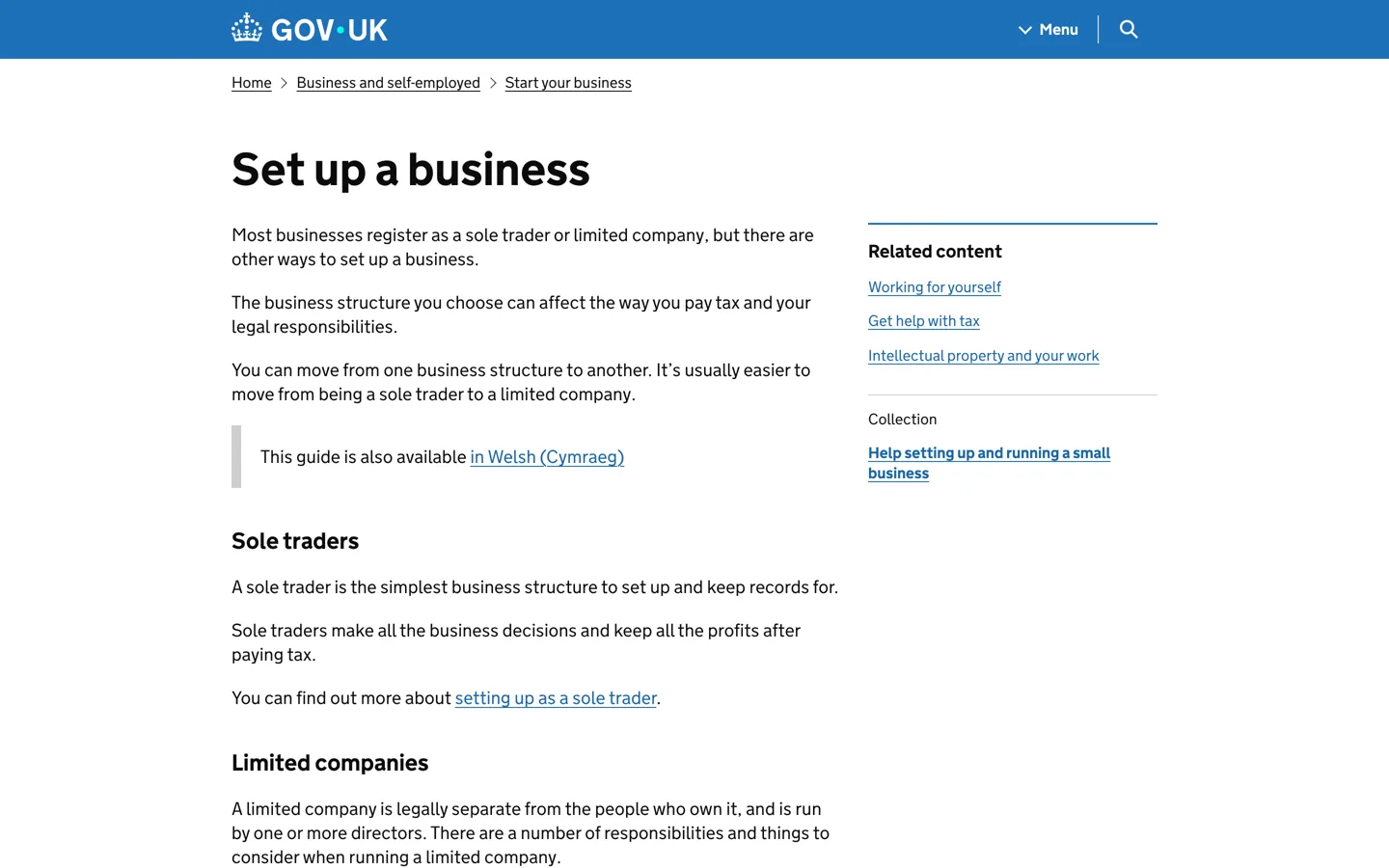
- United Kingdom: GOV.UK says most businesses register as a sole trader or limited company. As a sole trader you can start trading straight away, but you must register for Self Assessment if you earn more than £1,000 in a tax year (6 April to 5 April), and you must keep records from the start. A limited company is legally separate from its owners, with limited liability but more rules on accounts and taking money out.
The UK also has a tax-free trading allowance of up to £1,000 a year, according to HMRC, though there are circumstances where you must still register and declare the income. If in doubt, ask an accountant before your first sale.
Step 6: Choose a name and claim it
Pick a name that’s easy to say and spell, check that the domain is available, and claim the same username on the social platforms you’ll use. Our guides to generating name ideas and checking username availability cover both. In the UK, GOV.UK notes a sole trader can use a trading name or their own name, while limited companies have rules for names.
Step 7: Build a simple website
Your website is the one place online you fully control. Start small: a home page that says who you help and how, a page for your offer, an about page, a contact page and, for a content business, your first articles. WordPress on low-cost hosting is enough for most new businesses; our guide to cheap WordPress hosting compares options and renewal prices. Add a way to collect email addresses from day one.
Step 8: Find your first ten customers by hand
Early customers rarely arrive by themselves. Tell people you know, answer questions in communities where your customers spend time, offer your service to a few people at an introductory price in exchange for feedback, and follow up personally. Ten real customers teach you more about your offer, price and message than months of guessing, and their testimonials, shared with permission, help win the next ten.
Step 9: Measure, then grow what works
Track a few numbers each month: visitors, email subscribers, enquiries, sales and profit. Look at where customers came from and double down on that channel. Drop what isn’t working. Growth usually comes from doing a few things consistently, not from trying every tactic at once. A simple monthly spreadsheet with these numbers is enough; the trend over six months matters more than any single month.
Pricing your first offer
New business owners usually charge too little. Look at what similar services or products cost, then price within that range rather than far below it; very low prices attract customers who leave as soon as someone cheaper appears. For services, work out the hours a project really takes, including emails and revisions, and make sure the price covers them. For products, include platform and payment fees in the profit per sale. You can always offer an introductory discount to your first few customers in exchange for feedback, and raise the price as your results and reviews grow.
How much does it cost to start?
A content or service business can start with a domain and hosting, a few dollars a month, plus your time. Digital products add a sales platform or plugin; shops add stock, packaging and shipping. Write every cost down from the start, including software trials that will renew, so you know your real monthly costs and break-even point. Keep business money in a separate account from day one; the SBA lists opening a business bank account as one of its launch steps.
Running it alongside a job
Most online businesses start as side projects. GOV.UK notes you can be employed and self-employed at the same time. Check your employment contract for rules on outside work and conflicts of interest, block regular time in your calendar, and set a modest goal, such as your first paying customer in 90 days, rather than quitting before the business pays.
Common mistakes
- Building for months before anyone has paid for anything.
- Choosing a market that’s too broad to stand out in.
- Ignoring tax and records until the first tax return is due.
- Spending on tools and ads before the offer has been tested.
- Copying someone else’s business exactly, instead of serving a customer they miss.
- Giving up too early: most online businesses take months to find their footing.
Your first 30 days
- Week 1: choose the problem, the customer and the model; write your one-sentence promise.
- Week 2: talk to ten potential customers and check search demand.
- Week 3: write the one-page plan, set up the legal basics and register a domain.
- Week 4: launch a simple site and offer, and ask your first prospects to buy.
Questions people ask
How can I start an online business with no money?
Start with a service or content business that needs only a domain, hosting and your time, test it with a few customers, and reinvest early income.
What is the easiest online business to start?
Selling a service based on a skill you already have, such as writing or design, usually earns soonest. A blog is cheap to start but slower to earn.
Do I need to register my online business in the UK?
Sole traders can start trading straight away, but must register for Self Assessment if they earn more than £1,000 in a tax year, and must keep records from the start.
What do I need to do legally in the US?
The SBA's launch steps cover choosing a business structure and name, registering, getting tax ID numbers, licences and permits, a business bank account and insurance.
Can I run an online business while employed?
Yes; GOV.UK notes you can be employed and self-employed at the same time. Check your employment contract for rules on outside work.
How long does it take to make money?
It varies. Services can earn in weeks; content sites and products often take months. Aim for a first paying customer within 90 days.
Sources
- Business guide (US Small Business Administration) www.sba.gov · checked October 12, 2026
- Set up a business (GOV.UK) www.gov.uk · checked October 12, 2026
- Set up as a sole trader (GOV.UK) www.gov.uk · checked October 12, 2026
- Tax-free allowances on property and trading income (HMRC) www.gov.uk · checked October 12, 2026

Building websites since 2006: 500+ web projects of every size and $300K+ in website deals sold or brokered. Founder of A Digital Motive and DigiFlippers. I share the whole process here, plainly.
Founder of A Digital Motive and DigiFlippers