- Most partnerships fail on unclear expectations, not sales.
- Look for shared goals and values, and different skills.
- Say what each partner will give and expects to get.
- Write roles, money, decisions and the exit plan down.
- Test the partnership on a small project first.
How to choose a business partner comes down to three questions: do you share the same goals and values, do your skills fill each other’s gaps, and have you agreed in writing who does what, who owns what and what happens if one of you leaves? Most partnerships that fail don’t fail on sales or profit. They fail because the partners never said clearly what they expected. This guide covers what to look for, the conversations to have before you start, what to put in writing, and the lessons I learned from my own partnership, checked on 12 October 2026.
Thinking about how to run the business day to day? Our guide on writing a business plan helps you set shared goals. This page is about the partner.

What I learned from my own partnership
The partnership. In 2017 I started an advertising agency with a friend, a talented graphic designer. Together we served several companies with their design, printing, digital marketing and other online needs, and we ran the agency together for four years.
Where it started to pull apart. Over time it became clear that our skills were pulling the business in two different directions. My partner’s strength was design; mine was building and growing websites. The agency’s work kept moving me away from what I did best, and that, more than money or clients, was the real reason the partnership couldn’t last.
The decision. In 2021 we dissolved the partnership. It let me return to the work I’m best at.
What came next. I then built my own company, A Digital Motive, on my own terms. Today it’s my main company and the parent company behind all my work, from web development and SEO to buying and selling websites.
Those are exactly the conversations the rest of this guide sets out, so you can have them before you need them, not after.
Do you need a business partner at all?
A partner can bring skills, money, contacts and energy you don’t have, and someone to share decisions and pressure with. But a partner also means sharing control and profit, and every decision takes two people. Before you look for one, ask what exactly you’re missing. If it’s a skill, you might hire a freelancer or an employee. If it’s money, a loan or an investor may suit you better. If it’s someone to talk decisions through with, a mentor or an advisory group might be enough. Choose a partner when you need someone who is as committed to the business as you are, for the long term.
How to choose a business partner: qualities to look for
- Shared goals: you want the same thing from the business: how big, how fast, and whether you plan to sell it one day or run it for life.
- Shared values: you agree on how to treat customers, staff and money. A partner who suggests cutting ethical corners will do it with your name on the business too.
- Different skills: if you’re good at marketing, look for someone strong in the technical side, finance or operations, not another marketer.
- Commitment: they’re as motivated as you are, and when one of you is discouraged, the other keeps going.
- Reliability: they turn up, keep deadlines and do what they say. Agree in advance how many hours each of you will work.
- Loyalty: they won’t start a competing business a year later.
- Good communication: you can disagree openly, without sulking or shouting, and reach a decision.
Friends, family or strangers?
Starting a business with a friend or relative is common because trust is already there, but it’s also the riskiest kind of partnership, because if the business fails you can lose the relationship as well. A friend can still be the right partner. The difference is treating it as a business relationship from day one: the same honest conversations, the same written agreement, and keeping business arguments separate from the friendship. With someone you know less well, take time to work together on a small project first, and check their track record with people they’ve worked with before.
Have these conversations before you start
Each partner should say, honestly and out loud:
- What you expect to get: income, a salary, a share of profit, the chance to sell later, or flexibility.
- What you’re willing to give: money, hours each week, skills, contacts and equipment.
- How the balance works: if one partner puts in more money and the other more time, how does that affect ownership and profit?
- Who does what: a clear split of the workload and areas of responsibility.
- How decisions are made: which decisions either of you can make alone and which need both of you.
- Personal and professional roles: how you’ll keep a friendship or family relationship separate from business decisions.
- The initial investment: exactly who puts in what, and whether it’s a loan to the business or a stake in it.
Good business partnerships are like good marriages in one way: the prenuptial agreement and the plan for a split are prepared at the beginning. The split may never happen, but if it does, everyone already knows what belongs to whom.
Put it in writing: the partnership agreement

Whatever your legal structure, write down what you’ve agreed. The US Small Business Administration describes a partnership agreement as an internally binding document between all partners that defines how business decisions get made and each partner’s duties, powers and responsibilities. At a minimum, cover:
- Ownership: each partner’s share and what each contributed.
- Roles and hours: who’s responsible for what, and the time each will put in.
- Money: how profits are split, what each partner can draw, and how expenses are approved.
- Decisions: what needs agreement from all partners, and how deadlocks are broken.
- New partners: how someone joins, and what they must contribute.
- Leaving: notice periods, how a departing partner’s share is valued and bought, and whether they can compete afterwards.
- Disputes: how you’ll resolve disagreements, for example mediation before anything else.
- Ending the business: how assets and debts are divided if you close.
Have a solicitor or lawyer review the agreement. It costs far less than a dispute later.
Choosing the legal structure
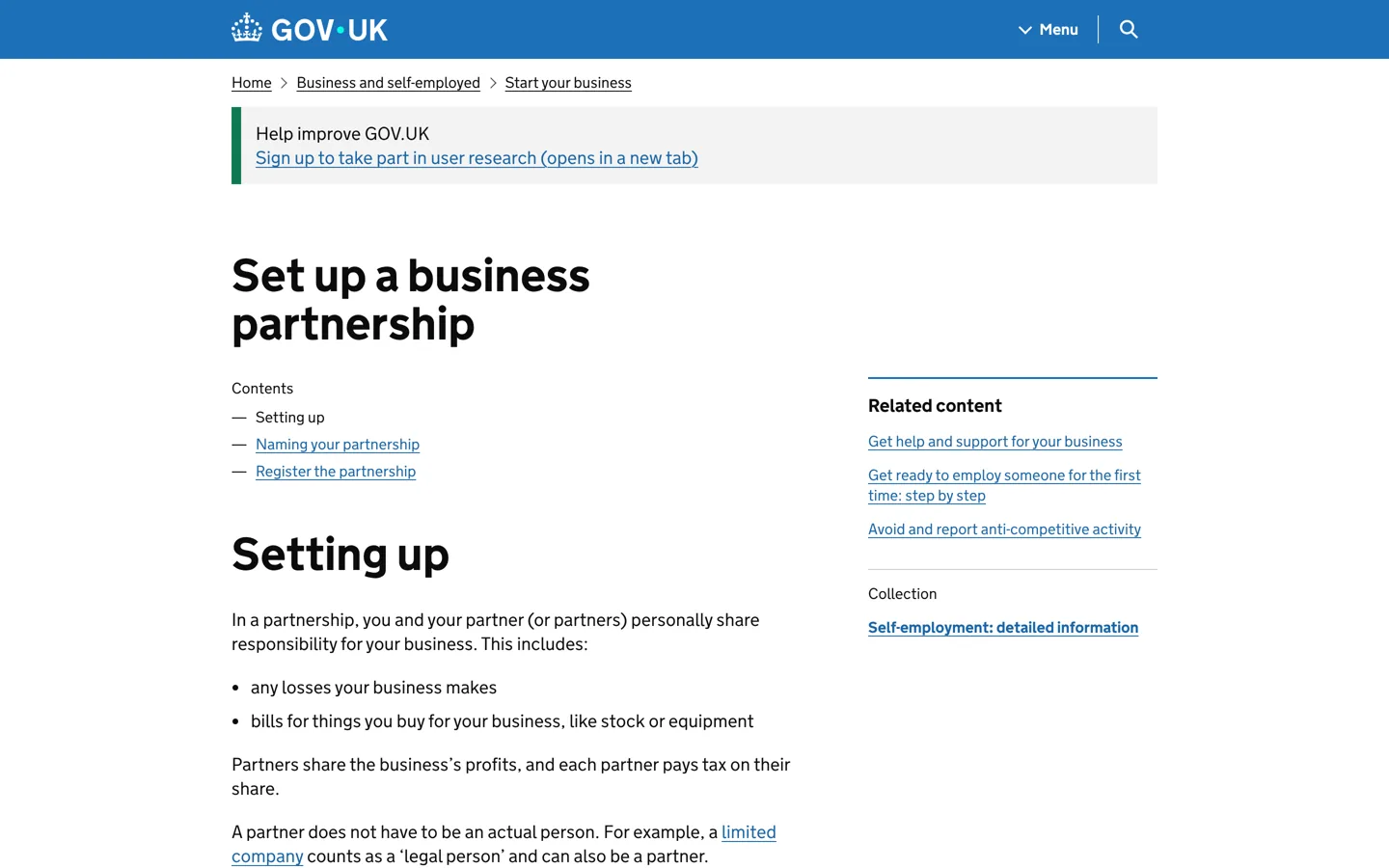
The structure you choose changes who’s responsible if things go wrong. In the UK, GOV.UK explains that in an ordinary partnership the partners personally share responsibility for the business, including any losses and bills for things the business buys, that partners share the profits and each pays tax on their share, and that you need to choose a “nominated partner” who manages the partnership’s tax returns and records. You must register with HMRC by 5 October in the business’s second tax year, or you could be charged a penalty. Limited partnerships and limited liability partnerships (LLPs) have different rules.
A limited company is another option. GOV.UK says it is legally separate from its owners, who are responsible for business debts only up to the value of their investment. In the US, the SBA describes partnerships as the simplest structure for two or more people to own a business together, and explains that limited liability partnerships protect each partner from the partnership’s debts. Rules differ by country, so get local advice before you register. Our guide on starting an online business covers the basics of setting up.
Test the partnership before you commit
Before signing anything long term, work together on something small: a pilot project, a first product or a three-month trial with clear goals. You’ll learn how the other person handles deadlines, pressure, money and disagreement far faster than in any interview. If the trial goes badly, it’s much easier to walk away from a small project than from a registered business with shared debts.
Keeping the partnership healthy
- Meet regularly, weekly or monthly, to review numbers, progress and anything that’s bothering either of you.
- Share the numbers: both partners should see the accounts at any time.
- Raise problems early, while they’re small, and talk about the issue, not the person.
- Review the agreement each year, or when something big changes, such as new investment or one partner reducing their hours.
- Celebrate wins together and give each other credit in public.
Warning signs in a potential partner
- They avoid putting anything in writing.
- They want an equal share without an equal contribution.
- Their story about past businesses or partners doesn’t add up.
- They dismiss your concerns instead of discussing them.
- They suggest shortcuts with tax, customers or staff.
- Their goals for the business keep changing.
Common mistakes
- Choosing a partner because they’re a friend, not because the business needs what they bring.
- Splitting ownership 50/50 by default, without discussing who contributes what and how deadlocks are broken.
- No exit plan: not agreeing what happens if one partner wants to leave.
- Unclear roles, so work is duplicated or forgotten and resentment builds.
- Ignoring different directions: carrying on when partners’ skills and goals pull the business apart, instead of talking about it early.
Take your time. It isn’t easy to find the right partner, but it’s worth the time and energy, because the choice affects every decision the business makes afterwards. And when you’re ready to build your reputation together, our guide to becoming a thought leader in your field explains how to earn trust as the face of a business.
Questions people ask
How do I choose the right business partner?
Look for someone with the same goals and values, skills that fill your gaps, and a record of reliability, then agree roles, money and an exit plan in writing before you start.
Is it a good idea to start a business with a friend?
It can work, but treat it as a business relationship from day one: the same honest conversations, a written agreement, and business disagreements kept separate from the friendship.
What should a partnership agreement include?
Ownership and contributions, roles and hours, how profits are split, how decisions and deadlocks are handled, how a partner leaves, how disputes are resolved and how the business would close.
Are partners responsible for business debts in the UK?
In an ordinary partnership, GOV.UK says partners personally share responsibility for the business, including losses and bills. Limited liability partnerships and limited companies have different rules.
Should business partners split ownership 50/50?
Only if contributions are genuinely equal and you've agreed how to break a deadlock. Otherwise base shares on what each partner brings in money, time and skills.
How do I know if a business partnership will work?
Work together on a small pilot project first. You'll see how the other person handles deadlines, pressure, money and disagreement before you commit.
Sources
- Set up a business partnership (GOV.UK) www.gov.uk · checked October 12, 2026
- Set up a limited company (GOV.UK) www.gov.uk · checked October 12, 2026
- Choose a business structure (US Small Business Administration) www.sba.gov · checked October 12, 2026

Building websites since 2006: 500+ web projects of every size and $300K+ in website deals sold or brokered. Founder of A Digital Motive and DigiFlippers. I share the whole process here, plainly.
Founder of A Digital Motive and DigiFlippers