Some links on this page are affiliate links. If you buy through them I may earn a commission, at no extra cost to you. It never changes a rating. Read the disclosure
- Firewall and DDoS protection from Cloudflare are on for every Kinsta site.
- The Kinsta CDN is on by default, supports HTTP/3 and includes free bandwidth.
- Edge caching is free and can make sites up to 40% faster, says Kinsta.
- Kinsta's CDN test cut load times by up to 44%, but three locations were slower.
- With your own Cloudflare account, set SSL/TLS to Full to avoid redirect loops.
Every site on Kinsta runs behind Kinsta’s Cloudflare integration at no extra cost: an enterprise-level firewall and DDoS protection, an HTTP/3 CDN that’s on by default, and optional edge caching that stores your pages in Cloudflare’s 300+ data centres. This guide explains what each part of the Kinsta Cloudflare setup does, how to turn it on, what Kinsta’s own speed tests show, and how to add your own Cloudflare account if you need more control. Everything comes from Kinsta’s documentation, checked on 12 October 2026.
Choosing a host rather than tuning one? Our Kinsta review covers plans and support, and Kinsta vs SiteGround compares two popular options. This page is only about Kinsta and Cloudflare.

How the Kinsta Cloudflare integration works
Kinsta chose Cloudflare to provide three things on top of its hosting:
- Security: Kinsta’s documentation says its free Cloudflare integration secures all sites hosted on Kinsta with an enterprise-level firewall and DDoS protection. You don’t switch it on; it’s always there.
- The Kinsta CDN: a content delivery network that serves your static files (images, CSS, JavaScript, fonts) from Cloudflare’s network, with HTTP/3 support and free bandwidth. It’s enabled by default on all new sites.
- Edge caching: stores the cached HTML of your pages in Cloudflare’s data centres, so the whole page, not just its files, can be delivered from near each visitor. It’s free on all plans but you turn it on per site.
You don’t need a Cloudflare account or a separate caching plugin for any of this. The integration works through Kinsta’s own setup, and you manage it from the Caching section of MyKinsta.
The Kinsta CDN
A CDN keeps copies of your static files on servers around the world. When a visitor in London loads a site hosted in the US, the images and scripts come from a nearby Cloudflare location instead of crossing the Atlantic. Kinsta’s documentation notes that Cloudflare’s network spans 300+ cities in more than 100 countries.
Two practical points from Kinsta’s guide:
- It uses your own domain. If you used a different CDN before and its address is set in your theme, a plugin or hard-coded in files, remove or replace it with your site’s own URL when you switch.
- It doesn’t work with password protection. Kinsta says you can’t enable the CDN or edge caching while password protection is on.
What Kinsta’s speed test shows

Kinsta tested its CDN on a 3.2 MB WordPress page with more than 30 static files, hosted in Iowa, from 10 locations. Load times fell by up to 44% (Amsterdam and London), but Kinsta’s own results also show the CDN slightly slower in three locations: Dallas (+17.75%), San Francisco (+9.09%) and Bangalore (+8.80%). Kinsta points out that locations near the server may see no boost. The lesson: a CDN helps most when your visitors are far from your data centre.
Edge caching: pages served from near your visitors
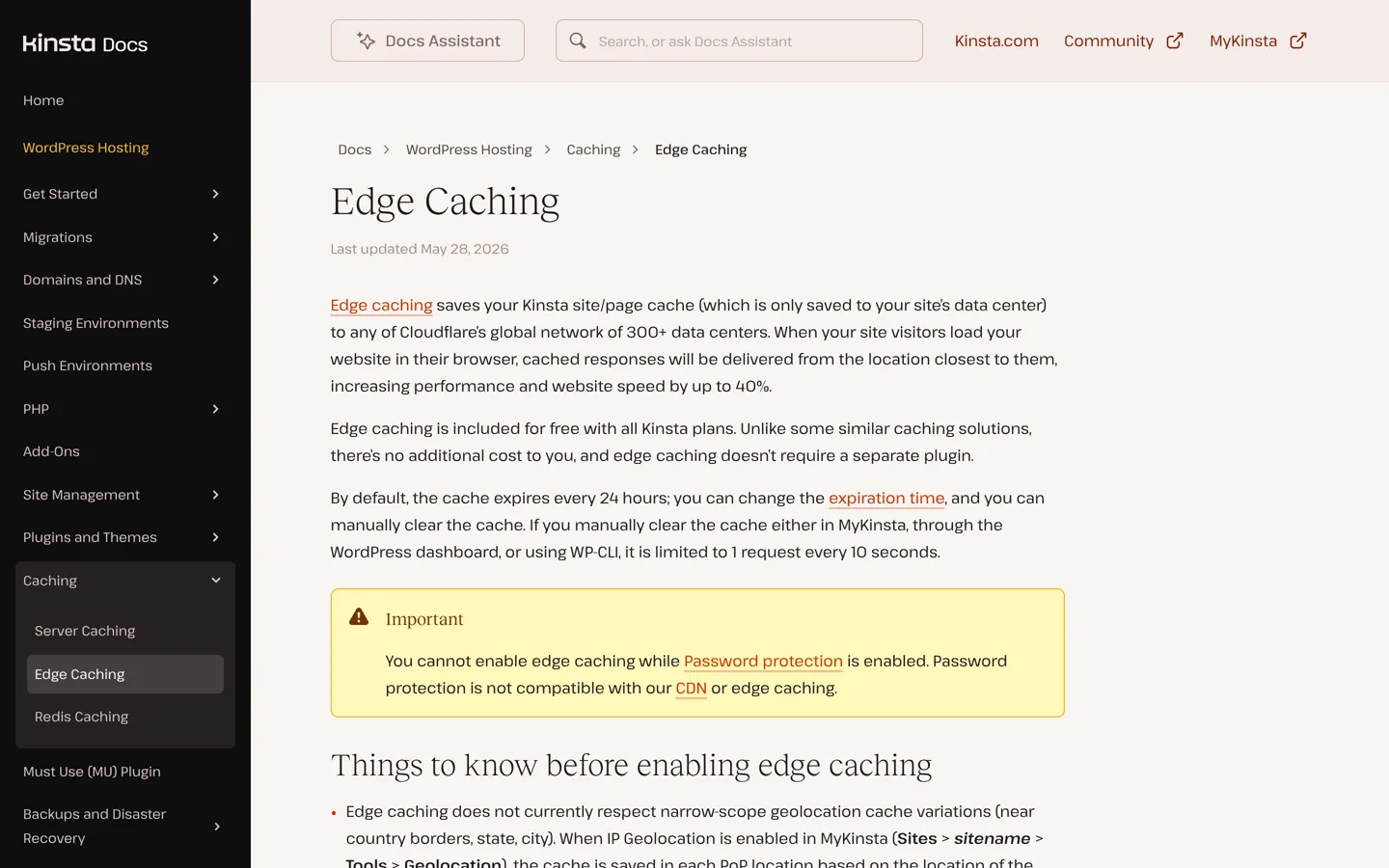
Kinsta’s server cache normally lives only in your site’s data centre. Edge caching copies those cached pages to Cloudflare’s 300+ data centres. Kinsta says this can improve speed by up to 40%, needs no plugin and costs nothing extra.
How to turn it on
- In MyKinsta, go to Sites → your site → Caching → Edge Caching.
- Click Enable, then Enable Edge Cache to confirm.
- If your site sends different HTML to phones, enable Mobile Cache too. Kinsta notes you don’t need it if your theme is responsive, using the same markup for every device.
To enable it on several sites at once, select them on the Sites page and use Actions → Caching → Change edge caching.
Know the limits before you enable it
- The edge cache expires every 24 hours by default; you can change this or clear it manually. Manual clearing is limited to one request every 10 seconds.
- It doesn’t respect narrow geolocation variations (state, city, near borders). With IP geolocation on, each location caches the version its first visitor saw.
- Advanced custom cache exclusions, such as combinations of custom cookies and URLs, aren’t respected. If Kinsta’s support team has set custom cache rules for your site, check with them first; MyKinsta warns you when it detects such rules.
- Like the CDN, it can’t run while password protection is on.
Kinsta’s caching layers, and how to clear them
Kinsta’s caching guide lists four options under Sites → your site → Caching in MyKinsta: edge caching, the CDN, server caching (full-page caching in Kinsta’s data centre) and Redis, an object cache available as an add-on. They work together: the server cache saves building pages again, edge caching moves those pages closer to visitors, and the CDN does the same for images and files.
When you change something and don’t see it, clear the caches in the right order. Kinsta recommends clearing any theme or plugin cache first, then using Caching → Clear all caches in MyKinsta, which clears the server, CDN and edge caches together (and Redis if you use it). The Kinsta MU plugin, installed by default on every Kinsta site, also lets you clear the cache from the WordPress dashboard, and you can use WP-CLI if you prefer the command line.
How to check the Kinsta Cloudflare setup is working
You can see whether a page came from Cloudflare’s cache by looking at its response headers. Open your browser’s developer tools, choose the Network tab, reload the page and click the first request. Cloudflare adds a cf-cache-status header. According to Cloudflare’s documentation, HIT means the resource was found in Cloudflare’s cache, MISS means it was eligible for caching but fetched from your server this time, and BYPASS means Cloudflare chose not to cache it. Reload once more after a MISS; a HIT on the second request shows edge caching is doing its job. Logged-in pages are usually not cached, so test in a private window.
Using your own Cloudflare account with Kinsta
Kinsta says its free integration works well for most customers, but you can add your own Cloudflare account on top if you want finer control or a Cloudflare feature the integration doesn’t offer. Kinsta notes there’s no minimum Cloudflare plan required.

- Add your domain in Cloudflare and let it scan your DNS records.
- Check the records it copied, so email and other services keep working.
- Replace A records with CNAMEs: point the root domain and www to
[sitename].hosting.kinsta.cloud, where [sitename] is the database name on your site’s Info page in MyKinsta, with the orange-cloud proxy turned on. - Change your name servers at your registrar to Cloudflare’s. Your DNS is then managed at Cloudflare, so you can no longer use Kinsta’s DNS. Kinsta says the site should stay up during the change.
- Set SSL/TLS to Full in Cloudflare. Kinsta’s guide says Flexible SSL is the usual cause of “too many redirects” errors.
The Cloudflare WordPress plugin isn’t required, but Kinsta recommends it for automatic cache purging, a fix for comments appearing to come from the same IP address, and access to Cloudflare settings and analytics from your dashboard.
Troubleshooting Kinsta and Cloudflare
- Changes don’t show up: with your own Cloudflare account there’s an extra cache layer. Kinsta suggests clearing every layer: plugin and theme caches, Kinsta’s site cache, Cloudflare’s cache and your browser.
- “Too many redirects”: switch Cloudflare’s SSL/TLS mode from Flexible to Full.
- Error 520 or 521: Cloudflare-specific errors meaning the server sent an unexpected response (520) or refused the connection (521). If you don’t use your own Cloudflare account, send Kinsta’s support the time, the Cloudflare Ray ID shown under the error and what you were doing.
- Error 1020 Access Denied: a firewall rule was triggered, often by direct access to a protected address.
- Need to pause Cloudflare? Kinsta says Cloudflare’s pause feature isn’t compatible with its integration; switch the CNAME records to DNS only for a while instead.
Which sites benefit most
- Sites with visitors far from the data centre. Kinsta’s own test showed the largest gains in Europe and Asia for a site hosted in Iowa. If most readers are in another country or continent, the CDN and edge caching matter more.
- Blogs and content sites where every visitor sees the same page are ideal for edge caching.
- Sites that get traffic spikes, for example from a newsletter or social post, because cached pages served by Cloudflare take load off your server.
- Sites that need extra protection benefit from the always-on firewall and DDoS protection, whatever their audience.
Is it worth turning everything on?
For most sites, yes: the firewall and CDN are already on, and edge caching is a free, quick win for blogs and brochure sites whose pages are the same for every visitor. Be more careful with shops, membership sites and pages that change per visitor; test edge caching on a staging site first and check logged-in pages, carts and checkouts still behave. And remember that caching can’t fix a slow theme or heavy plugins. Our on-page SEO checklist covers the Core Web Vitals targets to aim for, and the best managed WordPress hosting list compares Kinsta with other hosts that include similar features.
Questions people ask
Does Kinsta use Cloudflare?
Yes. Kinsta's free Cloudflare integration secures every site with an enterprise-level firewall and DDoS protection and powers its HTTP/3 CDN.
Is Kinsta's edge caching free?
Yes, on all plans, with no plugin needed. Turn it on in MyKinsta under Sites → your site → Caching → Edge Caching.
Do I need my own Cloudflare account with Kinsta?
No. The integration works without one. You can add your own account on any Cloudflare plan if you need more control.
Why do I get too many redirects with Cloudflare on Kinsta?
Usually Cloudflare's SSL/TLS mode is set to Flexible. Kinsta's guide says to set it to Full.
Does the Kinsta CDN always make my site faster?
Not everywhere. Kinsta's own test cut load times by up to 44%, but three of ten locations were slightly slower, and visitors near your data centre may see no boost.
Can I use edge caching with password protection?
No. Kinsta says password protection isn't compatible with its CDN or edge caching.
Sources
- Kinsta CDN (Kinsta docs) kinsta.com · checked October 12, 2026
- Edge caching (Kinsta docs) kinsta.com · checked October 12, 2026
- Use your Cloudflare account with Kinsta (Kinsta docs) kinsta.com · checked October 12, 2026
- Cloudflare errors (Kinsta docs) kinsta.com · checked October 12, 2026
- CDN overview (Kinsta docs) kinsta.com · checked October 12, 2026
- Caching (Kinsta docs) kinsta.com · checked October 12, 2026
- Cloudflare cache responses developers.cloudflare.com · checked October 12, 2026

Building websites since 2006: 500+ web projects of every size and $300K+ in website deals sold or brokered. Founder of A Digital Motive and DigiFlippers. I share the whole process here, plainly.
Founder of A Digital Motive and DigiFlippers