- Start with a one-page lean plan; expand only for funding.
- The SBA's lean plan has nine parts, from customers to costs.
- Break-even is where total cost equals total revenue.
- Divide monthly costs by profit per sale to see sales needed.
- Turn the plan into three to five measurable goals.
A business plan for an online business can be a single page. The US Small Business Administration (SBA) describes two common formats: a detailed traditional plan, which lenders and investors usually ask for, and a lean startup plan that “can take as little as one hour to make” and is typically one page. For a blog, online store or digital service you’re funding yourself, start lean: your customer, your offer, how people will find you, how you’ll make money, your costs and when you’ll break even. This guide walks through each part with an online example, based on the SBA’s and UK government’s guidance, checked on 12 October 2026.
Still choosing what to build? Our guide on how to start an online business covers the steps from idea to launch. This page is about putting the plan on paper.

Why write a business plan for an online business?
The UK government describes a business plan as a document covering “objectives, strategies, sales, marketing and financial forecasts”, and lists four uses: to clarify your idea, spot potential problems, set out your goals and measure your progress. It adds that you’ll need one if you want investment or a bank loan. The SBA calls it a roadmap for how to structure, run and grow your business.
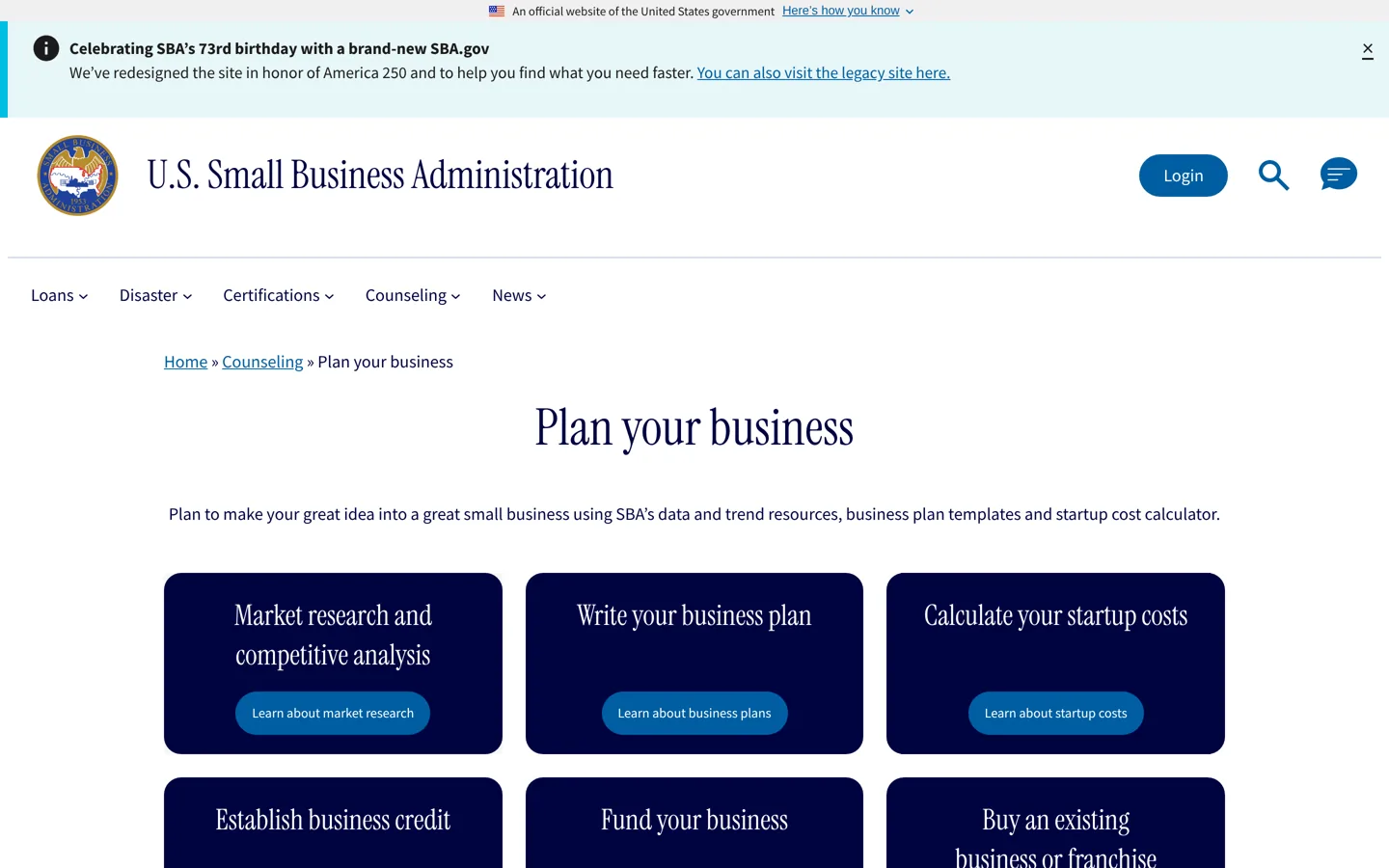
Online businesses are cheap to start, which makes it tempting to skip the plan. But cheap isn’t free: hosting, tools, ads and your own time all cost something. A one-page plan makes you decide who you’re serving and how you’ll earn before you spend months building.
Lean or traditional: which do you need?
- Lean plan: one page, the most important points only. Best when you’re funding the business yourself and want to test the idea quickly.
- Traditional plan: detailed, often dozens of pages, with a standard structure. The SBA says lenders and investors commonly request this type.
Most online businesses should start lean and expand to a traditional plan only when they need outside money. The lean plan becomes the outline for the longer one.
The nine parts of a lean business plan
The SBA describes nine components for a lean startup plan. Here’s each one, with an example for a small online business: a blog and digital shop teaching beginners to bake sourdough at home.
- Value proposition: “a clear and compelling statement about the unique value your company brings”. Example: step-by-step sourdough for beginners, with videos and printable schedules.
- Customer segments: be specific about whom you serve; the SBA notes your business “won’t be for everybody”. Example: home bakers who have failed with sourdough once.
- Channels: the main ways you’ll reach customers. Example: search traffic to the blog, a weekly email, short videos.
- Customer relationships: how customers interact with you, automated or personal, online or in person. Example: free guides, then an email course, with replies to questions.
- Revenue streams: how you’ll make money; the SBA gives examples such as direct sales, membership fees and selling advertising space. Example: a $19 digital course, display ads and affiliate links to equipment.
- Key activities: what gives you a competitive advantage. Example: tested recipes with photos of every stage.
- Key resources: assets you’ll use, such as staff, capital or intellectual property. Example: your recipes, a camera, your email list.
- Key partnerships: businesses you’ll work with. Example: a flour mill’s affiliate program, a course platform.
- Cost structure: whether you’ll focus on low cost or high value, and your biggest costs. Example: hosting, email software, course platform, ingredients for testing.

Work out your startup costs and break-even point
The SBA recommends calculating startup costs so you can estimate profits, run a break-even analysis and, if needed, request funding. It defines the break-even point as the point “at which total cost and total revenue are equal”, with no loss or gain.
For an online business, list one-off costs (domain, theme, design, equipment) and monthly costs (hosting, email software, tools, ads). Then divide your monthly costs by the profit from one sale to see how many sales you need each month to break even. An illustration: if the sourdough business costs $120 a month to run and keeps about $15 from each $19 course sale after fees, it needs 8 course sales a month to break even (120 ÷ 15 = 8). That number tells you how many readers and email subscribers you need, which tells you how much content to create.
Add the details lenders expect, if you need funding
If you’ll apply for a loan or approach investors, expand into the traditional sections the SBA lists: an executive summary, company description, market analysis, organisation and management, service or product line, marketing and sales, a funding request and financial projections. The SBA says the funding request should explain how much you need over the next five years and what you’ll use it for. In the UK, the government page points to a free business plan template on The King’s Trust website, and to free cash flow forecast and business plan templates on the Start Up Loans website.
Research that makes the plan real
- Search demand: are people searching for what you’ll offer? Our guide to keyword research shows how to check.
- Competitors: the SBA suggests looking at what successful competitors do, why it works, and whether you can do it better.
- Prices: what do similar products, courses or services cost?
- Your niche: is it specific enough to stand out? See our guide on how to choose a blog niche.
Set goals you can measure
A plan is only useful if you check it. Turn it into three to five measurable goals for the next six months, for example: publish 24 helpful posts, reach 500 email subscribers, sell 10 courses a month by month six. Review them monthly. If a channel isn’t working, the plan shows you what to change instead of guessing.
Choose a legal structure and keep records
The SBA’s traditional plan asks you to describe your legal structure, such as sole proprietor, limited liability company (LLC), partnership or corporation in the US. Rules differ by country, so check your government’s guidance or ask an accountant before you start trading. Whatever the structure, keep business income and costs separate from personal money from day one; it makes your break-even figures accurate and your tax return easier.
A one-page plan template
Copy these headings into a document and write one or two lines under each:
- Who it’s for (customer segment)
- What problem it solves and why you (value proposition)
- How people will find it (channels)
- How it makes money (revenue streams, with prices)
- What it costs each month (cost structure)
- Break-even: sales needed per month
- Three goals for the next six months
- Biggest risk, and what you’ll do about it
Three quick examples
Illustrations of how the most important lines of a lean plan might read for three common online businesses:
- A niche blog: for first-time campervan owners; free guides found through search; earns from display ads and affiliate links to equipment; costs hosting and an email tool; breaks even at a few thousand monthly visitors; first goal, 30 helpful posts in six months.
- A small online shop: handmade leather wallets for people who want them engraved; found through social media and search; earns from direct sales with a set profit per wallet after materials, platform and payment fees; breaks even at a set number of wallets a month; first goal, 20 reviews from real customers.
- A freelance service: website copy for local dentists; found through referrals and a portfolio site; earns per project; costs software and a little advertising; breaks even with one project a month; first goal, three case studies with permission to share results.
Notice that each one names a specific customer, a channel and a number to aim for. That’s what makes a plan useful rather than decorative.
How your plan should change as you grow
Treat the first version as a set of guesses to test. After three months, look at what actually happened: which channel brought visitors, what people bought, and what it really cost. Update the plan with real numbers, drop what isn’t working and put more time into what is. When the business grows, add sections as you need them, such as a hiring plan, a budget for advertising or a cash flow forecast, rather than writing them all on day one. Keep every version, so you can see how your thinking changed and which assumptions turned out to be right.
Common mistakes
- Writing for an imaginary investor when you only need a plan for yourself.
- “Everyone” as the customer, which makes every other section vague.
- Revenue without a channel: sales forecasts with no plan for how buyers will find you.
- Forgetting platform fees and payment costs in the profit per sale.
- Never updating it: a plan should change as you learn what customers actually want.
Once the plan is written, the next step is building. Our overview of ways to earn money from a blog covers the revenue streams most online businesses start with.
Questions people ask
Do I need a business plan for an online business?
Not legally, but a short plan helps you decide who you serve and how you'll earn before you spend months building. You'll need a fuller one if you want a loan or investment.
What is a lean business plan?
A short plan, typically one page, that summarises only the most important points. The SBA says it can take as little as an hour.
What should a one-page business plan include?
Your customer, your offer and why it's different, how people will find you, how you'll make money, your costs, your break-even point and a few measurable goals.
How do I calculate my break-even point?
Divide your monthly costs by the profit you keep from one sale. The answer is the number of sales a month you need to cover your costs.
When do I need a traditional business plan?
When you apply for a bank loan or approach investors; the SBA says lenders and investors commonly request it.
Where can I get a free business plan template?
The SBA offers example lean and traditional plans, and the UK government points to free templates from The King's Trust and Start Up Loans.
Sources
- Plan your business (US Small Business Administration) www.sba.gov · checked October 12, 2026
- Write a business plan (GOV.UK) www.gov.uk · checked October 12, 2026

Building websites since 2006: 500+ web projects of every size and $300K+ in website deals sold or brokered. Founder of A Digital Motive and DigiFlippers. I share the whole process here, plainly.
Founder of A Digital Motive and DigiFlippers