- Shopify, BigCommerce and Wix all start at about $29 a month billed yearly.
- WooCommerce is free, but hosting runs $25 to $350 a month for most stores, says WooCommerce.
- Shopify adds 2% on Basic if you use an outside payment provider.
- Squarespace Basic charges a 2% online store transaction fee; higher plans charge 0%.
- BigCommerce plans now have yearly sales limits, so costs rise with revenue.
The best ecommerce platforms for most small businesses are Shopify (the easiest all-in-one store), WooCommerce (free software for WordPress sites), BigCommerce (strong built-in features), and Wix or Squarespace if your store is part of a wider website. This guide compares the five best ecommerce platforms, plus Magento for large custom builds, using prices and fees from each company’s own pricing page, checked on 12 October 2026, with the pros and cons of each.

Best ecommerce platforms compared
| Platform | Starting price | Card rates from | Best for |
|---|---|---|---|
| Shopify | $29/mo yearly ($39 monthly) | 2.9% + 30¢ (Basic) | Most new online stores |
| WooCommerce | Free plugin + hosting | Depends on processor | WordPress sites, full control |
| BigCommerce | $29/mo yearly ($39 monthly) | 2.89% + 29¢ | Growing stores, B2B |
| Wix | $29/mo yearly (Core) | Varies by country | Small shops on a design-led site |
| Squarespace | $19/mo yearly (Basic) | 2.9% + 30¢ (Basic) | Creatives, small catalogues |
| Magento Open Source | Free software + hosting + developers | Depends on processor | Large custom stores |
Prices are in US dollars and exclude tax. Wix’s US prices were checked on its plans page on 12 October 2026.

1. Shopify: the easiest all-in-one store
Shopify gives you hosting, checkout, payments, themes and an app store in one subscription. Plans are Basic at $29 a month billed yearly ($39 monthly), Grow at $79 ($105), Advanced at $299 ($399), and Plus from $2,300 a month for large businesses. New stores get a 3-day free trial, then $1 a month for 3 months.
Online card rates with Shopify Payments start at 2.9% + 30¢ on Basic and fall to 2.7% on Grow and 2.5% on Advanced. If you use an outside payment provider instead, Shopify adds a third-party transaction fee of 2% on Basic, 1% on Grow and 0.6% on Advanced.
- Pros: quickest to launch; reliable hosting and checkout; huge app and theme choice; sells online, in person (with POS) and on social channels.
- Cons: extra fees if you don’t use Shopify Payments; useful apps add monthly costs; less control over the underlying code than self-hosted software.
Already have a domain? Our guide to connecting a Namecheap domain to Shopify shows how.
2. WooCommerce: free and flexible on WordPress
WooCommerce is a free plugin that turns a WordPress site into a store. It’s the most widely used option here on WordPress.org, with 7,000,000+ active installations, rated 4.5 from 4,800+ reviews, and was updated on 9 October 2026.
The software is free, but you pay for the rest. WooCommerce’s own pricing page estimates hosting at $25 to $350 a month for most stores, depending on traffic, and extensions at $29 to $299 a year each. Card fees depend on the payment processor you pick, including WooCommerce’s own WooPayments.
- Pros: no platform fee; full ownership and control; thousands of plugins and themes; your blog and store share one site.
- Cons: you manage hosting, updates, security and backups; costs add up with paid extensions; more setup than a hosted platform.
Choosing hosting for a store? Our guide to WordPress hosting explains the types, and the best WordPress hosting ranking compares hosts.
3. BigCommerce: more built in
BigCommerce lists four plans: Core at $39 a month ($29 billed yearly), Growth at $105 ($79), Scale at $399 ($299) and Performance from $1,499 a month. BigCommerce now ties plans to sales: the Scale plan, for example, covers up to $33,333 a month in gross merchandise value, with a 0.9% overage rate above that, and accounts move up to Performance automatically at $2 million in yearly sales. Card processing starts at 2.89% + 29¢ on all plans.
- Pros: many features built in rather than added by apps; flexible for B2B and larger catalogues; works with many payment providers.
- Cons: sales-based plan limits mean costs rise with revenue; fewer themes and apps than Shopify; the editor takes longer to learn.
4. Wix: a store inside a design-led website
Wix is a website builder first. Its plans run from Light ($17 a month yearly) to Core ($29), Business ($39) and Business Elite ($159); selling online starts on Core, with fuller ecommerce features on Business. There’s a free plan, but it can’t sell, and paid plans come with a 14-day money-back guarantee. Every paid plan on Wix’s plans page also includes a free domain for the first year.
- Pros: easy drag-and-drop design; store, bookings and blog in one; free domain for the first year.
- Cons: less suited to large catalogues; fewer specialist ecommerce tools than Shopify or BigCommerce.
5. Squarespace: polished design for small catalogues
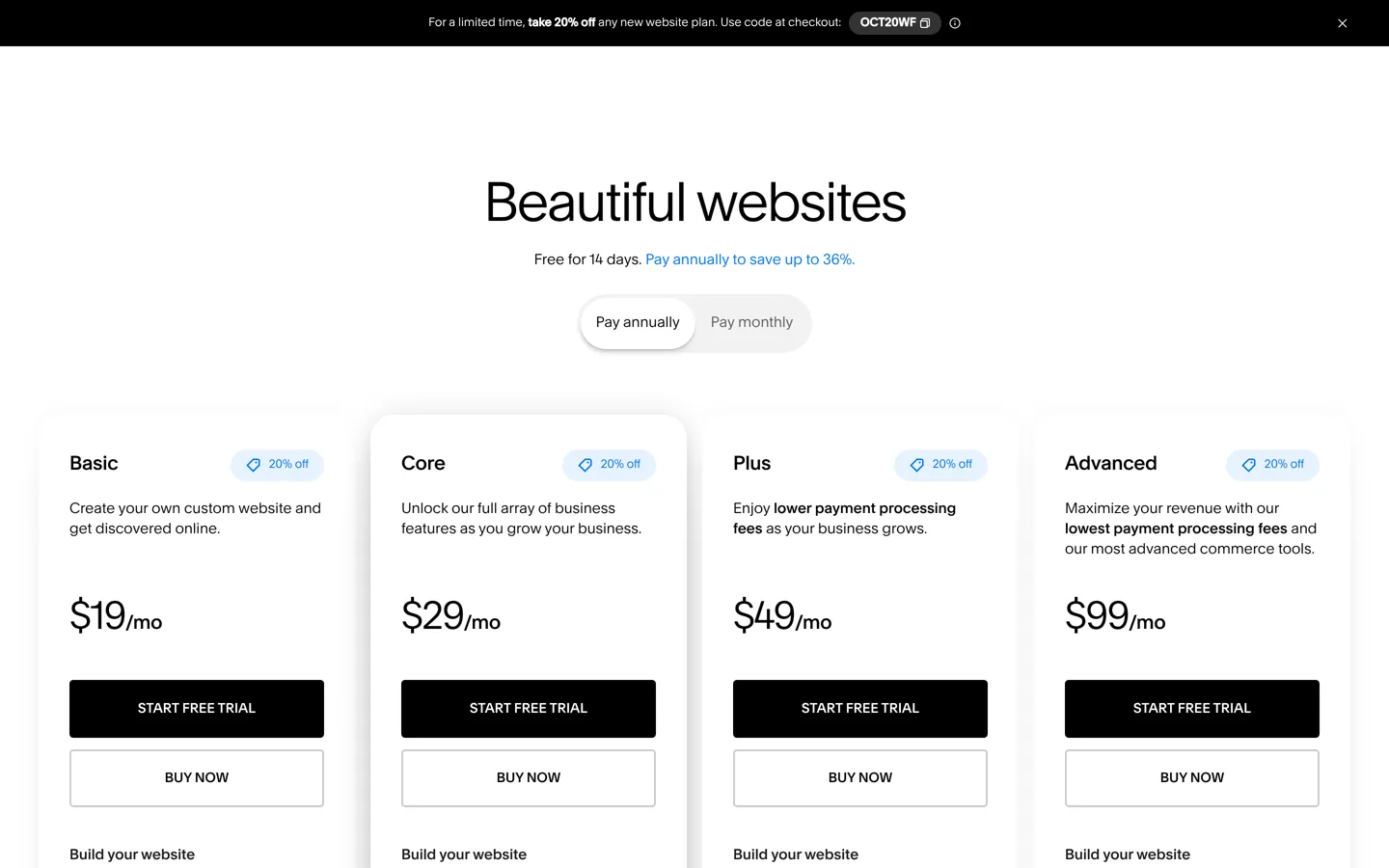
Squarespace plans cost $19 a month (Basic), $29 (Core), $49 (Plus) and $99 (Advanced) billed yearly. Card rates start at 2.9% + 30¢ on Basic and drop to 2.5% on Advanced. Watch the platform fee: Basic adds a 2% online store transaction fee, which falls to 0% from Core upwards.
- Pros: beautiful templates; good for selling a small range, services or digital products alongside a portfolio.
- Cons: 2% transaction fee on the cheapest plan; fewer integrations; not built for large or complex stores.
Also consider: Magento Open Source and Adobe Commerce
Adobe describes Magento Open Source as a free, open-source platform that anyone can download, install and extend. It’s powerful and endlessly customisable, but it needs developers and capable hosting, which is where the real cost lies. Adobe Commerce is Adobe’s paid, cloud-hosted version for large businesses; Adobe doesn’t publish its prices, so expect a sales quote. Choose this route only if you have a development team or budget.
The fees beyond the monthly price

- Card processing: every platform charges it, typically 2.5% to 2.9% plus about 30¢ per online sale in the US, lower on higher plans.
- Platform transaction fees: Shopify charges them only if you use an outside payment provider; Squarespace only on Basic.
- Apps and extensions: reviews, subscriptions, email marketing or advanced shipping often cost extra each month or year.
- Themes: free themes work; premium themes are usually a one-off cost.
- Domain and email: often free for the first year, then renewed at the regular price.
Add these up for your expected sales, not just the plan price. A cheaper plan with a 2% transaction fee can cost more than a pricier plan once sales grow.
Worked example: a small store’s monthly cost
To see how fees change the picture, take a small store selling $1,000 a month from 20 orders of $50, paid online by card. Using each platform’s published yearly-billed plan price and starting online card rate:
| Platform and plan | Plan | Card fees | Other fees | Total |
|---|---|---|---|---|
| Shopify Basic (Shopify Payments) | $29 | $35 | $0 | $64 |
| BigCommerce Core | $29 | $34.70 | $0 | $63.70 |
| Squarespace Basic | $19 | $35 | $20 (2%) | $74 |
| Squarespace Core | $29 | $35 | $0 | $64 |
| WooCommerce | $25 hosting (low end) | About $35 | Extensions extra | About $60+ |
An illustration from published US rates, not a quote: card fees are 2.9% + 30¢ per order (2.89% + 29¢ for BigCommerce); WooCommerce assumes a similar card rate and WooCommerce’s lowest hosting estimate. Taxes, apps and themes are excluded.
Two lessons stand out. First, at small volumes the platforms cost about the same, so choose on features and ease of use. Second, a cheap plan with a transaction fee, such as Squarespace Basic, becomes the expensive option as sales grow: at $1,000 a month its 2% fee already cancels out the $10 saving on the plan.
Which ecommerce platform should you choose?
- Starting your first online store: Shopify.
- Already on WordPress, or want full ownership: WooCommerce.
- Larger catalogue or B2B with features built in: BigCommerce.
- A shop as part of a design-led website: Wix or Squarespace.
- Large, custom store with developers: Magento Open Source or Adobe Commerce.
Switching platforms later
Moving a store is possible but takes work, so it pays to choose carefully now. Products, customers and orders can usually be exported as CSV files and imported elsewhere, and paid migration apps and services exist for the popular routes, such as WooCommerce to Shopify or the reverse. What doesn’t move easily: your theme, app-specific features, reviews stored in an app, and saved payment methods for subscriptions.
The most important part is your web addresses. Product and category URLs are usually structured differently on each platform, so set up 301 redirects from every old address to its new one, or you’ll lose the search rankings and links you’ve built. Keep your own domain name from the start, registered in your name, so you can take it with you to any platform.
How to choose: six questions
- How many products will you sell? A handful suits Squarespace or Wix; hundreds or thousands suit Shopify, BigCommerce or WooCommerce.
- Who will run the technical side? If it’s no one, choose a hosted platform.
- What will it cost at your expected sales? Include card fees, transaction fees and apps.
- Where else will you sell? In person, on social media or on marketplaces: check each platform’s channels.
- Can you leave later? Export options for products, customers and orders matter if you ever switch.
- Do you need extras now? Subscriptions, digital downloads, bookings or wholesale pricing are built in on some platforms and paid add-ons on others, so list them before you compare prices.
Selling through a WordPress site? Our list of the best WordPress plugins covers security, backups and SEO for your store.
Questions people ask
What is the best ecommerce platform for beginners?
Shopify: hosting, checkout and payments are included, and you can launch without technical skills. New stores get 3 days free, then $1 a month for 3 months.
Is WooCommerce cheaper than Shopify?
The plugin is free, but you pay for hosting ($25 to $350 a month for most stores, says WooCommerce) and any paid extensions. For small stores the totals can be close.
Does Shopify charge transaction fees?
Not with Shopify Payments. With an outside payment provider it adds 2% on Basic, 1% on Grow and 0.6% on Advanced.
Which ecommerce platform has the lowest fees?
It depends on your sales. Card rates are similar (about 2.5% to 2.9% plus 30¢); avoid platform transaction fees, such as Squarespace Basic's 2%.
Is Magento still free?
Magento Open Source is free to download from Adobe, but it needs developers and strong hosting. Adobe Commerce, the paid version, is priced by quote.
Can I sell on Wix's free plan?
No. Selling online starts on Wix's Core plan ($29 a month billed yearly).
Sources
- Shopify pricing www.shopify.com · checked October 12, 2026
- WooCommerce pricing woocommerce.com · checked October 12, 2026
- WooCommerce (WordPress.org) wordpress.org · checked October 12, 2026
- BigCommerce pricing www.bigcommerce.com · checked October 12, 2026
- Wix plans www.wix.com · checked October 12, 2026
- Squarespace pricing www.squarespace.com · checked October 12, 2026
- Magento Open Source (Adobe) business.adobe.com · checked October 12, 2026

Building websites since 2006: 500+ web projects of every size and $300K+ in website deals sold or brokered. Founder of A Digital Motive and DigiFlippers. I share the whole process here, plainly.
Founder of A Digital Motive and DigiFlippers