Some links on this page are affiliate links. If you buy through them I may earn a commission, at no extra cost to you. It never changes a rating. Read the disclosure
- Namelix generates short, brandable names with what it calls a custom LLM.
- Name styles range from real words to invented, brandable names.
- Saving names teaches it your preferences over time.
- Real words or short phrases usually suit a blog best.
- Check domain, handles and trademarks before using any generated name.
Namelix is a business name generator from Brandmark.io that uses artificial intelligence to suggest short, brandable names. You type a few keywords, pick a name style (such as brandable, compound words or real words), set how random the results should be, and it shows a list of ideas; saving the ones you like teaches it your preferences. It’s useful for naming a blog, product or business, but the names it suggests still need checking for usernames, a domain and trademarks. This guide shows how to use Namelix well, from its own site, checked on 12 October 2026.
Found a name you like? Our guide to username availability checkers covers the next step. Thinking of using your own name instead? See using your own name as a domain.

What Namelix is
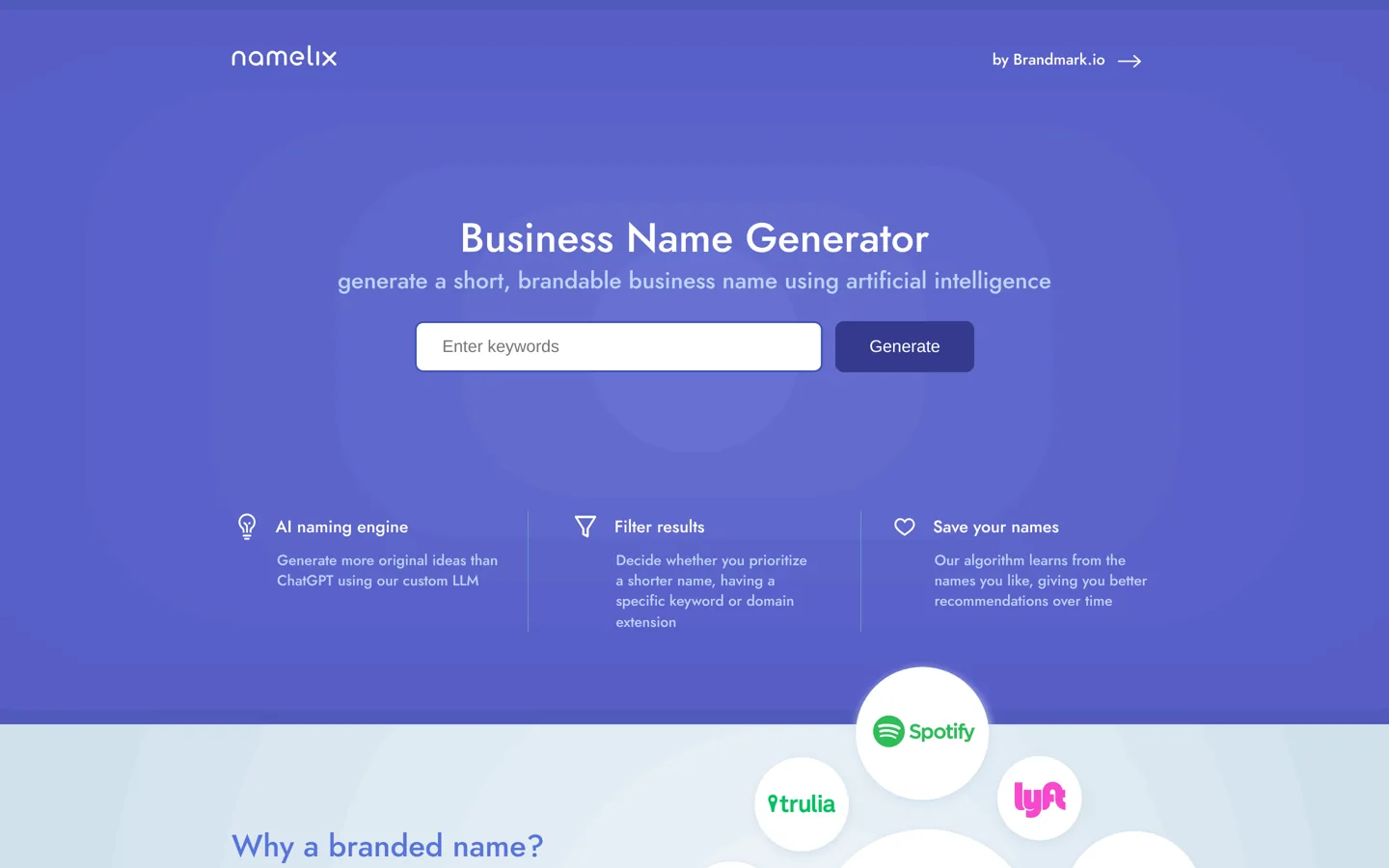
Namelix describes itself as a tool to “generate a short, brandable business name using artificial intelligence”, made by Brandmark.io. Its site makes three main points:
- It uses an “AI naming engine” built on what it calls a custom LLM (large language model).
- You can tell it whether you prioritise a shorter name, a specific keyword or a domain extension.
- When you save names, “the algorithm learns your preferences and gives you better recommendations over time”.
Namelix explains why it focuses on short, branded names: most generators “combine dictionary words to make longer names”, while short dictionary domains are expensive and long multi-word names “don’t inspire confidence”.
How to use Namelix, step by step
- Enter keywords that describe your blog or business: the topic, the reader, a feeling (“calm”, “fast”). Two or three words work better than a long sentence.
- Choose a name style. The generator offers styles with examples, including brandable names (like Google and Rolex), evocative names (like RedBull and Forever21), short phrases (like Dollar Shave Club), compound words (like FedEx and Microsoft), alternate spellings (like Lyft and Fiverr), non-English words (like Toyota and Audi) and real words (like Apple and Amazon). You can also choose all styles.
- Set the randomness: lower for names close to your keywords, higher for more creative ideas.
- Add brand info if asked, such as a short description, to make suggestions more relevant.
- Save names you like. Each save helps the generator learn your taste, so keep going for a few rounds.
Which name style suits a blog?

- Real words or short phrases suit most blogs, because they say what the blog is about and are easy to remember (“Quiet Garden Notes”).
- Compound words work when you want something shorter that still hints at the topic.
- Brandable or alternate-spelling names suit products, apps and businesses that plan to grow beyond one topic, but they need more effort to explain at first.
A blog’s name also becomes its domain and handles, so prefer names that are easy to spell after hearing them once.
An example session
An illustration of how a session might go, for a blog about simple home espresso. The first round, with the keywords “espresso home beginner” and all styles, returns a mix: invented names, compound words and a few short phrases. Saving the ones with a warm, simple feel, and removing those that are hard to spell, narrows the taste. A second round with “coffee morning ritual” and only the real-words and short-phrase styles produces calmer, more descriptive ideas. A third round with low randomness refines the favourite direction. From around twenty saved names, five survive the say-it-aloud test, and two pass the domain and username checks.
Namelix or naming it yourself?
A generator is fastest when you’re stuck or want options you wouldn’t think of. Naming it yourself works well when you already know the feeling you want and the words your readers use. The best approach often combines the two: brainstorm a list of words that describe your reader, topic and tone, use those as Namelix keywords, then mix and edit the results by hand. The name you choose doesn’t have to be one the tool produced exactly; it can be one it inspired.
After Namelix: check before you commit
- Say it out loud to three people. If they can’t spell it, change it.
- Check usernames across the platforms you’ll use, with a checker and then on each platform.
- Check the domain with a registrar such as Namecheap.
- Search the trademark register for similar names in your field, such as the USPTO’s in the US.
- Search the name on Google to see what already appears for it.
A generated name isn’t automatically free to use. The checks take about half an hour and can save a painful rename later. Keep a note of what you checked and when, in case questions come up after you launch.
What makes a good blog or business name
- Short and easy to say. Fewer syllables are easier to remember and type.
- Relevant, or at least not misleading. A name that suggests the wrong topic confuses new readers.
- Room to grow. Avoid names tied to one product, year or platform.
- Distinct. It shouldn’t be easily confused with an existing brand in your field.
- Available as a domain and on the platforms that matter to you.
Getting better results from Namelix
- Change your keywords between rounds: synonyms, related ideas, the benefit rather than the topic.
- Try one style at a time once you know what you like, so results are more focused.
- Save generously at first, since saves train the suggestions, then prune your list.
- Take breaks: come back the next day and see which names still stand out once the excitement of finding them has faded.
- Shortlist five, then run each one through the checks above before you fall in love with it.
Different projects need different names
- A blog: clear and descriptive helps new readers understand the topic at a glance.
- A newsletter: can be more playful, because subscribers already know you.
- A product or app: a short, brandable name is easier to trademark and stand out with.
- A business with several services: choose something broad enough to cover what you might offer in five years.
If you’re naming a blog that might one day become a business, choose the name you’d be happy to see on an invoice.
Logos and branding from the same company
Namelix links to Brandmark.io, its maker’s logo tool. Brandmark says it creates logos and design assets such as business cards, social media graphics and one-page websites, edited in the browser and exported to SVG, PNG and PDF. It’s one option once you’ve chosen a name; our Namecheap Logo Maker review covers another, and our guide on designing a logo for a blog explains what makes a logo work.
Test your shortlist with real people
Before choosing, show your top three names to a handful of people who match your future readers, not just friends. Ask what each name makes them expect the blog to be about, and which they’d remember tomorrow. Their first reaction is valuable: if a name suggests the wrong topic or needs explaining, readers who see it in a search result will feel the same. Pick the name that’s remembered and understood, even if it isn’t the cleverest one on your list.
Using AI name ideas responsibly
AI tools can suggest names that resemble existing brands without telling you. Treat every suggestion as a starting point, not a finished answer: search for it, check trademarks and make sure it doesn’t copy a competitor’s identity. If a name feels familiar, it may be because someone already uses something close to it.
A naming session in 45 minutes
- 10 minutes: write the reader, the topic and three words for how you want the brand to feel.
- 15 minutes: run three rounds in Namelix with different keywords and styles, saving freely.
- 10 minutes: cut the list to five and say each aloud.
- 10 minutes: check domains and usernames for the top two.
Finish the trademark check before you register anything you plan to build a business on, and register the domain and main social handles on the same day you decide, so nobody else takes them first.
When a rename makes sense
Renaming an established blog costs time: a new domain, redirects from every old address, updated profiles and explaining the change to readers. It’s worth it when the old name blocks growth (it’s tied to a topic you no longer cover), causes confusion with another brand, or raises a trademark problem. If you do rename, move everything on the same day and redirect each old page to its new address, so no reader or search engine meets a dead link.
Common naming mistakes
- Falling for clever spellings that readers can’t type from memory.
- Choosing a name that’s too narrow for where the blog may go.
- Skipping the checks because the generator suggested the name.
- Waiting too long between choosing and registering the domain.
- Choosing a name that only works in one language when you hope to reach readers in other countries.
- Asking for opinions from people outside your audience and ignoring the readers you actually want.
Questions people ask
What is Namelix?
A business name generator by Brandmark.io that uses AI to suggest short, brandable names based on your keywords and chosen style, learning from the names you save.
Is Namelix free?
You can generate and save name ideas on its site without paying. Its sister product Brandmark.io sells logos and branding.
What name styles does Namelix offer?
Brandable names, evocative names, short phrases, compound words, alternate spellings, non-English words and real words, or all styles at once.
Can I use a name Namelix suggests?
Only after checking. Generated names may resemble existing brands, so check usernames, domains and the trademark register first.
Which Namelix style is best for a blog?
Usually real words or a short phrase, because they say what the blog is about and are easy to spell after hearing them.
Does Namelix check domain availability?
It lets you prioritise a domain extension, but confirm availability with a registrar before you decide.
Sources
- Namelix namelix.com · checked October 12, 2026
- Namelix generator (name styles) namelix.com · checked October 12, 2026
- Brandmark.io brandmark.io · checked October 12, 2026
- Trademark search (USPTO) www.uspto.gov · checked October 12, 2026

Building websites since 2006: 500+ web projects of every size and $300K+ in website deals sold or brokered. Founder of A Digital Motive and DigiFlippers. I share the whole process here, plainly.
Founder of A Digital Motive and DigiFlippers