- Choose a platform by the skill or time you can offer.
- Check each platform's fee or share before you start.
- Udemy pays 97% on your own coupon sales, 37% otherwise.
- Amazon Mechanical Turk closed on 30 September 2026.
- Real platforms take a share; scams ask you to pay first.
The best websites to make money online are platforms that pay you for a skill, your time or something you create: freelance marketplaces such as Upwork, testing sites such as UserTesting, local task apps such as TaskRabbit, course and ebook platforms such as Udemy and Amazon KDP, stock sites such as Shutterstock, and writing platforms such as Medium. None of them is a secret, and none pays well without effort. Each takes a fee or a share, which you should check before you start. This guide compares the main options by what you’re good at, with each platform’s own terms checked on 12 October 2026, and shows how to spot the scams that copy them.
Want income from your own site instead? Our guide on how to earn money from a blog covers ads, affiliate links and products. This page is about platforms that pay you.

Websites to make money online, by what you can offer
The fastest way to choose is to start with what you already have:
- A professional skill (writing, design, development, marketing): freelance marketplaces.
- Spare time and an opinion: product and website testing.
- Local availability: task and errand apps.
- Knowledge you can package: online courses, ebooks and tutoring.
- Creative work: stock photos, videos and illustrations.
- Something to sell: a website or online business you’ve built.
Freelance work: Upwork and Fiverr
Upwork connects freelancers with clients who post jobs. Its help centre says the freelancer service fee “ranges from 0% to 15% per contract”, is shown before you send a proposal or accept an offer, and stays fixed once a contract starts. Fiverr works the other way round: you list services (“gigs”) at set prices and buyers order them; check its current seller fees in its help centre before you price your work.
Freelancing pays best when you specialise. “Website copy for dental clinics” wins more work than “writer”, and a few strong samples matter more than a long profile. Our guide to keeping your first freelance clients covers what happens after the first job.
Testing websites and apps: UserTesting
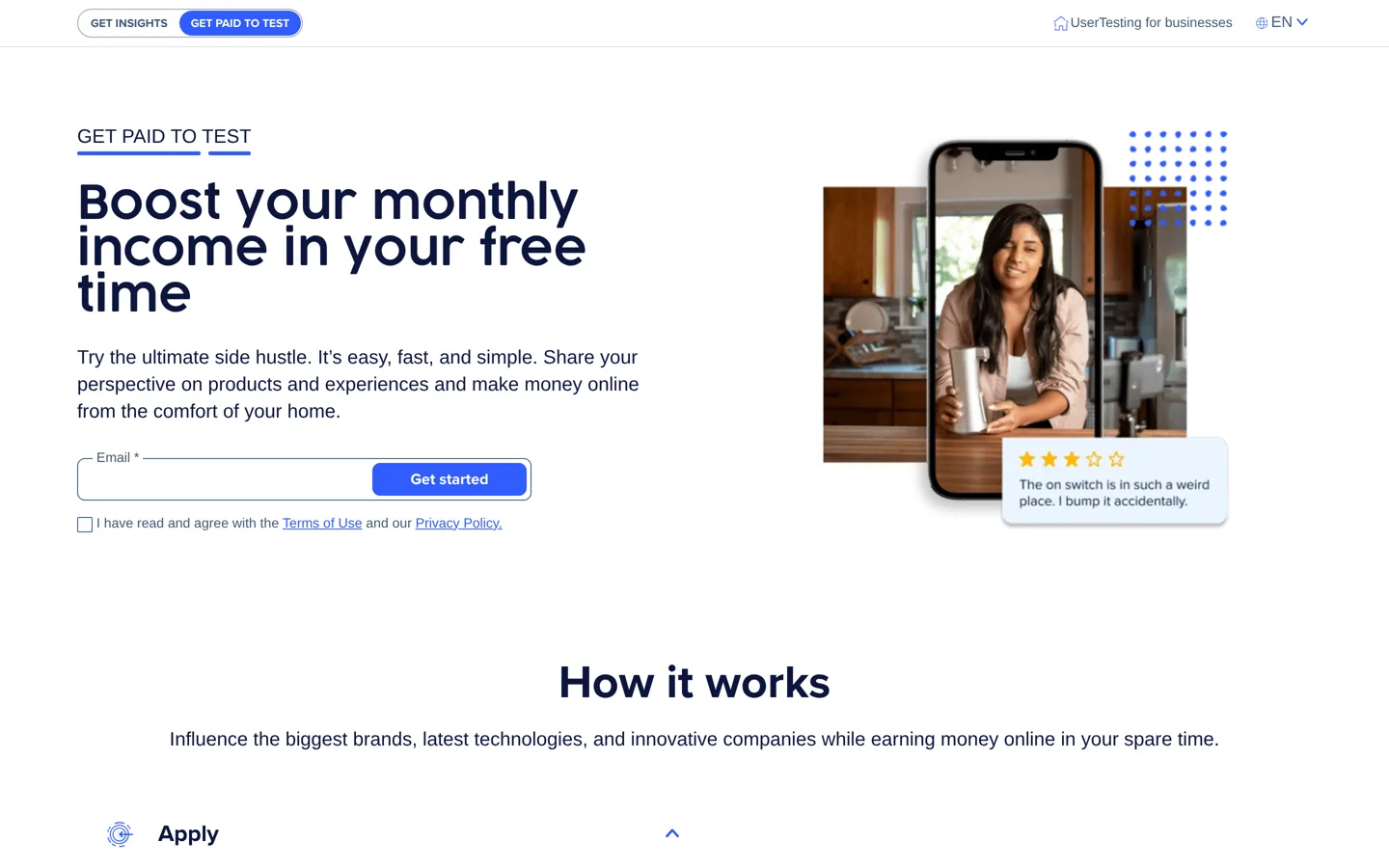
UserTesting pays people to give feedback on websites, apps and products. Its contributor page describes three kinds of work: answering questions without recordings, recorded tests where you speak your thoughts aloud, and live video conversations with a customer. It says reward amounts vary with the test type, length and demand, your dashboard shows what each test pays, and payments are usually sent 14 days after a completed test. You’ll take a short practice test to join. It’s flexible spare-time money, not a salary: tests come and go with demand.
Local tasks: TaskRabbit
TaskRabbit connects people with “Taskers” for jobs such as furniture assembly, moving help and handyman work in the cities where it operates. Its become-a-Tasker page says you set your own rates and keep 100% of what you charge, plus tips, and that in applicable cities there’s a $25 registration fee. It suits practical skills and reliable transport more than online skills.
Closed: Amazon Mechanical Turk
Amazon Mechanical Turk, a marketplace for small online tasks that appears in many older lists, is no longer an option: its website says it “permanently closed on September 30, 2026”. It’s a reminder to check that any platform a list recommends is still running, and still accepts new members from your country, before you spend time on it.
Teaching and courses: Udemy, Teachable and italki
Udemy‘s instructor revenue share depends on how the sale happens: instructors receive 97% of revenue when a student buys through the instructor’s own coupon or referral link, and 37% for sales that come through Udemy’s marketplace or ads. Both shares are of the net amount, after taxes and fees such as the 30% charged by Apple or Google on app sales. Udemy brings the audience; you give up most of the price on its sales.
Teachable lets you sell courses on your own branded school instead. Its pricing page lists a 7.5% transaction fee on the Starter plan and 0% on higher plans, with a 7-day free trial and a 30-day guarantee; you bring your own students.
For live lessons, italki is a marketplace for language teachers. It says teachers set their own prices and hours after their application is accepted, and that it has over 10 million students learning more than 150 languages.
Ebooks: Amazon KDP
Amazon KDP (Kindle Direct Publishing) lets you self-publish ebooks and choose between two royalty options: 35% of the list price without VAT, or 70% minus delivery costs (KDP gives an average of $0.06 per unit) for sales in eligible countries, with 35% elsewhere. Our guide to designing a 3D ebook cover covers the cover KDP needs and the mockup for marketing.
Stock photos and videos: Shutterstock
Shutterstock lets contributors upload photos, videos and illustrations and earn when customers license them. Its contributor site says it has paid “over $1 billion” to contributors since 2003, and it also offers licensing of contributors’ catalogues for AI training. Stock pays per download, so it rewards a large, well-tagged portfolio built over time.
Writing: Medium Partner Program
Medium‘s Partner Program pays writers a share of members’ subscription fees based on how members read and engage with their stories. Medium’s help centre says you need an active Medium membership and must meet its eligibility requirements, there’s no application review once you meet them, and payouts go through a connected Stripe account with verified tax information. It works best as a second home for writing you’d publish anyway.
Selling a website you’ve built
If you’ve built a blog or online business, selling it can be a one-off payday. Flippa says more than 50,000 sellers have sold an online business on its platform. DigiFlippers, which I founded, is another marketplace for buying and selling digital assets. Our guide to the websites to buy or sell websites compares the marketplaces.
How to spot a money-making scam

Real platforms take a share of what you earn; scams ask you to pay first. The UK’s police fraud reporting service describes work-from-home scams as offers to make easy money where the organiser makes you pay an advance fee, avoids paying you for work you’ve done, makes you buy worthless products, or makes you sign up others before you’re paid. It also warns about fake recruitment agents hiring for jobs that don’t exist, and about “money mules” who move criminals’ money, sometimes in exchange for payment.
- You’re asked to pay to start, for a “starter kit”, training or a deposit.
- The pay sounds too good for simple work like liking posts or copying text.
- You’re asked to receive and forward money or goods for someone.
- Contact comes out of nowhere, by message or social media, with pressure to act fast.
- The “platform” is only a chat group, with no real company, terms or support.
Sign up only on the platform’s own website, never through a link someone sends you, and never pay to unlock earnings. If you think you’ve been targeted, report it to your country’s fraud reporting service.
Getting started on your first platform
- Pick one platform that matches a skill or the time you have, using the list above.
- Read its fees, payout method and rules for your country before you create an account.
- Build a complete, honest profile with a real photo, a clear description and samples where they apply.
- Start small: a few tests, a first gig, one short course or a handful of stock photos, to learn how the platform works.
- Ask for feedback and reviews from your first clients or buyers; they matter most on marketplaces.
- Review after a month: hours spent, money earned, and whether you enjoyed it. Keep, change or move on.
Keep your payment details, tax records and login security in order from the start: use a strong, unique password and two-factor authentication on any platform that pays you.
What you can realistically earn
Earnings vary hugely, and these platforms don’t publish averages you can rely on. As a rule, task and testing sites pay small amounts for your time; freelancing pays for skill and grows with reputation; courses, ebooks and stock can earn for months or years after the work is done, but start slowly. Treat the first month on any platform as an experiment: track the hours you put in and what you earned, and compare that hourly figure across platforms.
Mistakes to avoid
- Joining ten platforms at once instead of getting good at one or two.
- Ignoring fees, so a “$100 job” pays much less than you planned.
- Taking work off-platform against a marketplace’s rules, which can get your account closed.
- Forgetting tax: platform earnings are usually taxable income; keep records from day one.
- Chasing “secret” methods that promise quick money for little work.
The most dependable path is to pick one platform that matches a skill you have, build a track record there, and use what you learn to grow something of your own, such as a blog. For a step-by-step start, see our guide on how to start a blog.
Questions people ask
What websites actually pay you to work online?
Established platforms such as Upwork and Fiverr for freelancing, UserTesting for feedback on websites and apps, TaskRabbit for local tasks, Udemy, Teachable and italki for teaching, Amazon KDP for ebooks, Shutterstock for stock content and Medium for writing.
How much does Upwork take?
Upwork's freelancer service fee ranges from 0% to 15% per contract, shown before you send a proposal or accept an offer.
How does UserTesting pay?
Reward amounts vary by test type, length and demand, your dashboard shows each test's pay, and payments are usually sent 14 days after a completed test.
Is Amazon Mechanical Turk still available?
No. Its website says it permanently closed on 30 September 2026.
How much do Udemy instructors earn?
Udemy pays instructors 97% of the net amount on sales through their own coupon or referral link, and 37% on other marketplace sales.
How can I tell if a make-money website is a scam?
Be wary if it asks for an upfront fee, promises high pay for simple work like liking posts, asks you to move money or goods for others, or contacts you out of the blue.
Sources
- Freelancer Service Fee (Upwork) support.upwork.com · checked October 12, 2026
- Get paid to test (UserTesting) www.usertesting.com · checked October 12, 2026
- Become a Tasker (TaskRabbit) www.taskrabbit.com · checked October 12, 2026
- Amazon Mechanical Turk (closure notice) www.mturk.com · checked October 12, 2026
- Instructor revenue share (Udemy) support.udemy.com · checked October 12, 2026
- Pricing (Teachable) www.teachable.com · checked October 12, 2026
- Teach on italki teach.italki.com · checked October 12, 2026
- eBook royalties (Amazon KDP) kdp.amazon.com · checked October 12, 2026
- Shutterstock Contributor submit.shutterstock.com · checked October 12, 2026
- Enroll in the Medium Partner Program help.medium.com · checked October 12, 2026
- Sell on Flippa flippa.com · checked October 12, 2026
- A-Z of fraud (Report Fraud, UK police) www.reportfraud.police.uk · checked October 12, 2026

Building websites since 2006: 500+ web projects of every size and $300K+ in website deals sold or brokered. Founder of A Digital Motive and DigiFlippers. I share the whole process here, plainly.
Founder of A Digital Motive and DigiFlippers