- Buyers pay a multiple of profit, so lasting profit, proof and low risk add value; a new design alone rarely does.
- Pay only through escrow under an asset purchase agreement, and check every asset on a transfer list before releasing funds.
- Change little after the handover, then improve content, SEO, monetisation, conversion, operations and documentation.
- Hold long enough to show 12 months of improved results; Empire Flippers and Flippa's brokerage both look at 12 months.
- Keep a ledger and a separate account for every flip, and ask an accountant how a sale is taxed where you live.
If you want to learn how to flip websites for profit, think of it as a cycle rather than a trick: find a site worth more than its price, buy it safely, make it earn more and run more smoothly, hold it long enough to prove the new results, then sell it with clean records and hand it over properly. I’ve built websites since 2006, sold my first one on Flippa in 2016, and worked on more than 500 web projects since, with over $300,000 in website deals sold or brokered. This guide is the whole process in order, with the official rules and fees that apply at each step.
It’s the pillar for the topic, so the deep dives live on their own pages: the valuation and profit math in blog flipping economics, the full due diligence checklist in how to buy a blog, and the marketplaces side by side in where to buy or sell websites.

What website flipping is, and what it isn’t
Website flipping is buying (or building) a website, increasing what it earns and how reliably it earns it, then selling it for more than it cost you in money and time. Online businesses are usually priced as a multiple of their profit, so every lasting dollar of monthly profit you add raises the sale price several times over. That is the whole engine.
There are two routes. Build and sell costs little money but a lot of time, because a new site needs months of content and search growth before it earns. Buy, improve and sell needs capital but starts with traffic and income on day one. Many flippers do both: building teaches the skills, and buying applies them faster. If you are starting from nothing, starting an online business from zero and how blogs earn money are the right first reads.
What flipping isn’t: a quick cosmetic makeover. A new logo or theme rarely changes the price, because buyers pay for profit, proof and low risk. The work that pays is described in step 5.
Which kinds of websites flip well
Almost any online asset can be flipped, but each type asks for different skills. Pick the one that matches what you already do well.
| Asset | How it earns | Skills that add value | Main risk |
|---|---|---|---|
| Content sites and blogs | Display ads, affiliate links, sponsorships | SEO, writing, monetisation | Google updates and affiliate program changes |
| Small ecommerce stores | Product sales | Conversion, paid ads, supplier management | Stock, suppliers, thin margins |
| SaaS, tools and plugins | Subscriptions or licences | Product, support, churn reduction | Code quality and support load |
| Domains | Resale (sometimes leasing) | Naming, market timing | Money tied up until a buyer appears |
| YouTube channels and newsletters | Platform revenue, sponsors, products | Audience growth, sponsorship sales | Platform rules and creator dependence |
Content sites are where most people start, because the skills (SEO and content) are learnable and the sites are cheap to run. Stores need more operations work; our comparison of ecommerce platforms helps if you inherit one. Domains are a separate game with their own marketplaces; for registrars, see the Namecheap review, and remember that a site built on a personal name is harder to sell, as using your own name as a domain explains.
Step 1: Set your buying rules before you browse
Write your rules down first, so a persuasive listing can’t make the decision for you:
- Budget per deal: the most you can lose without real harm, plus a reserve for improvements and a few weak months after the handover.
- Asset type and income model: only ones you understand. If you’ve never run display ads or a store, don’t learn on your biggest purchase.
- Niches: topics where you can judge content quality and spot opportunities.
- Time: hours per week you can really give the site for a year or more.
- Exit idea: who would buy it from you, and on which kind of marketplace.
Step 2: Source deals
Good deals come from three places: public marketplaces, brokers, and direct outreach.
- Flippa is a large open marketplace with listings at every size, and its own payment and escrow options.
- Empire Flippers is a curated broker for established businesses: sites must make at least $24,000 a year in net profit with 12 months of history to be listed.
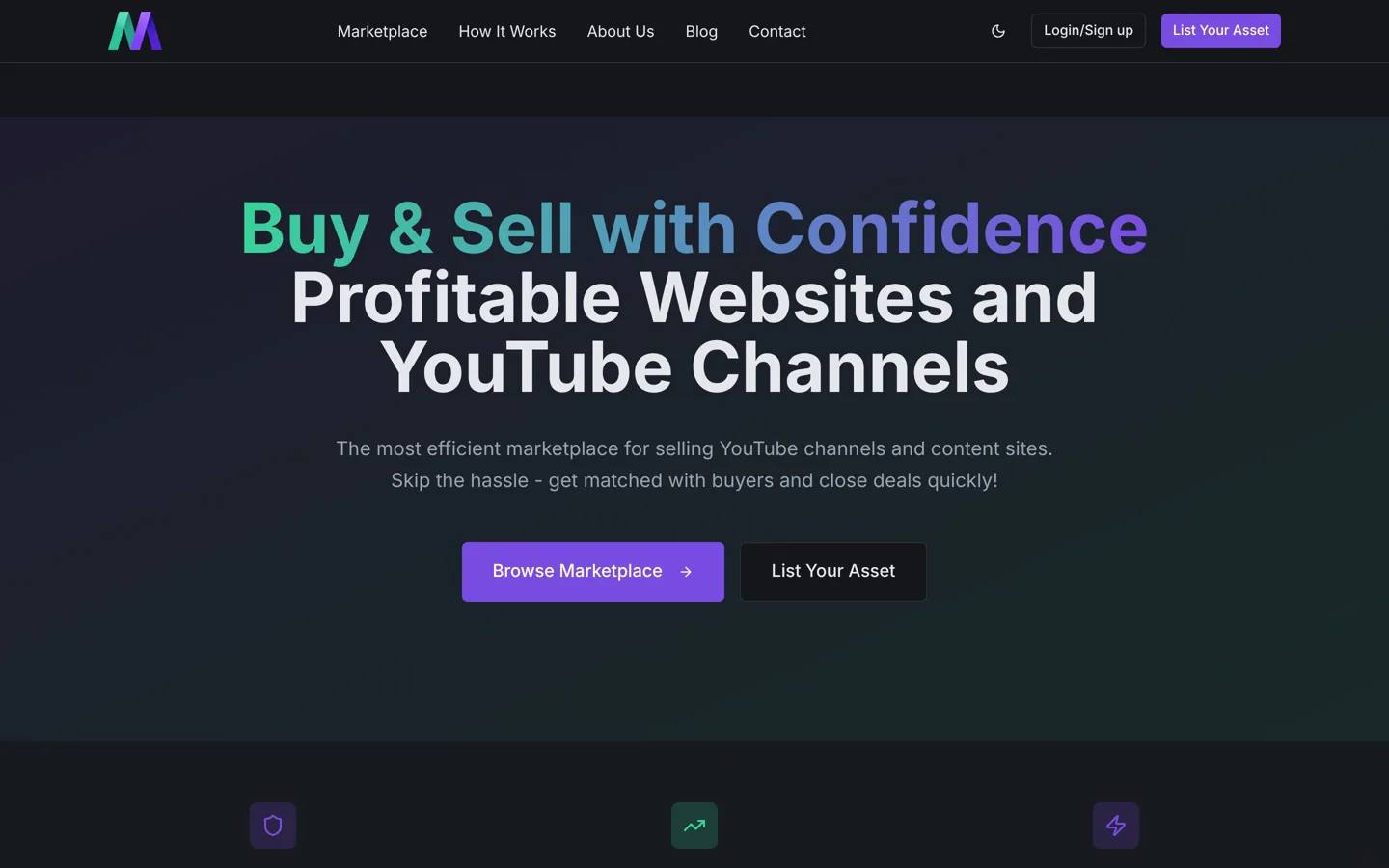
- Motion Invest focuses on content sites and YouTube channels, vets listings before they go live, and holds the buyer’s funds in escrow until the transfer is complete.
- Acquire.com is aimed at SaaS, ecommerce and other startups, with built-in tools for offers and agreements.
- DigiFlippers, my company, is a marketplace for buying and selling websites, domains, stores, apps and social accounts, with no success fee on sales up to $10,000.
Fees, buyer access and who each one suits are compared in detail on our website marketplaces page, so I won’t repeat them here.
Direct outreach finds sites that were never listed. Make a list of small sites in your niche that look neglected (old posts, outdated prices, no new content for a year) and send a short, polite email asking whether the owner would consider an offer. Many won’t reply; the few who do are often happy to sell without a public listing. The same checks and the same escrow apply to these deals.
Step 3: Run a quick evaluation, then full due diligence
Most listings fail a ten-minute filter. Before you spend hours on one, check:
- Where the traffic comes from. Mostly search, one social network, or paid ads? One source is fragile.
- Where the money comes from. One affiliate program or one page earning most of the income is a risk you must price in.
- The trend. Rising, flat or falling over 12 months? A falling site is only a deal if you know exactly why and how to fix it.
- The history. Old versions in the Wayback Machine show whether it was always this site, or an expired domain filled with new content.
- The work. How many hours a month does it take, and could you do them?
Listings that pass go to full due diligence: read-only access to analytics and every earnings account, a content and backlink review, Google’s spam and manual action checks, and questions for the seller. All of that is laid out step by step in our due diligence checklist for buying a blog. To see a site’s platform and tools before you ask, a lookup tool from our BuiltWith alternatives list helps.
Step 4: Buy safely: agreement, escrow and the transfer list
The buying step is where flippers lose money to fraud, not to bad judgement. Three things protect you.
A written asset purchase agreement
Most small website deals are asset purchases: you buy the domain, content and accounts, not the seller’s company. An asset purchase agreement (APA) sets out what is included, the price, how and when each asset moves, the inspection period, how long the seller will support you, and promises such as not starting a competing site. Several marketplaces now build these for you: Flippa and Acquire.com both offer letter of intent (LOI) and APA builders. For a larger deal, have a lawyer read it.
Escrow
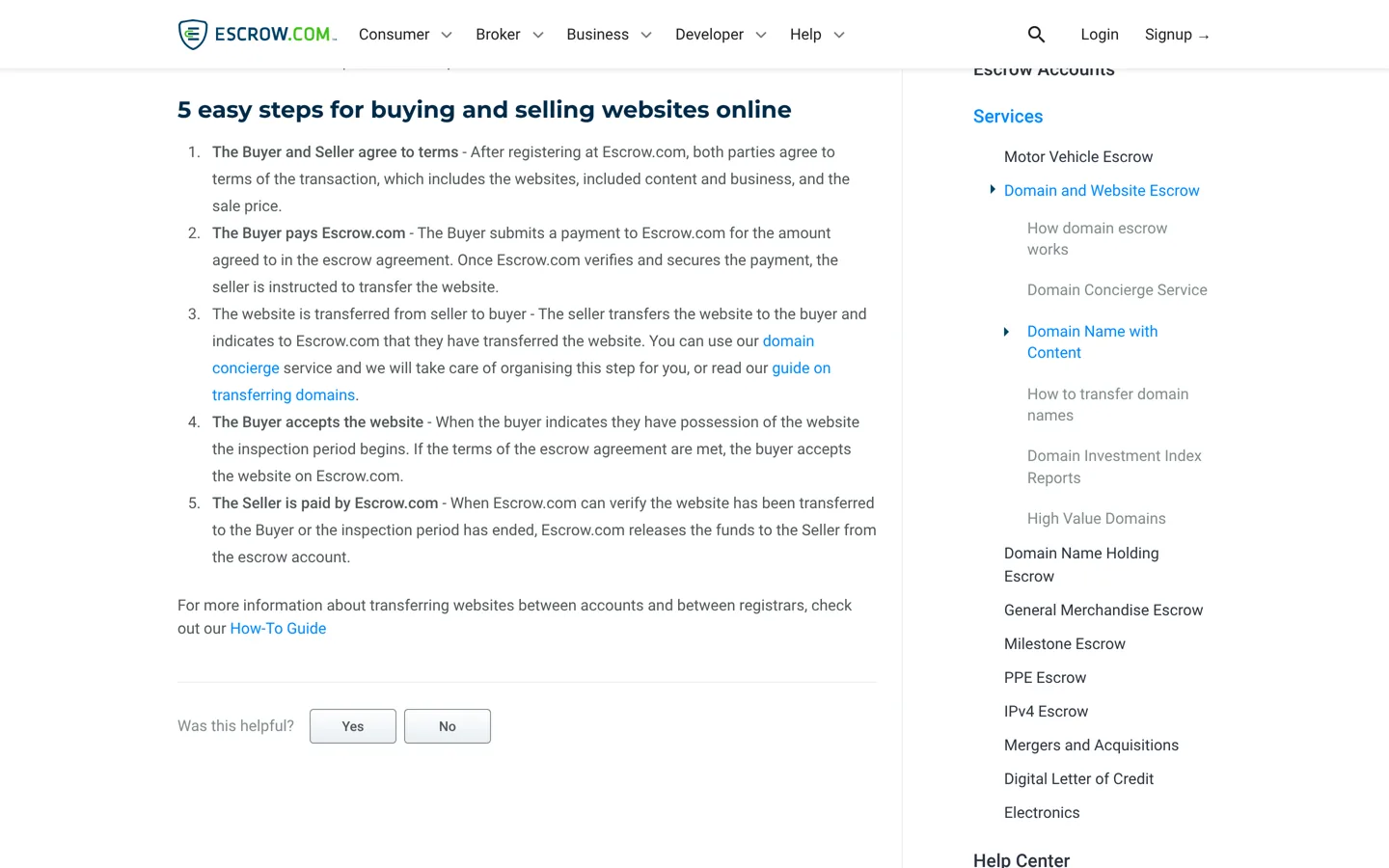
Never send money straight to a seller you don’t know. In escrow, a licensed third party holds your payment until you confirm you’ve received what you paid for. Escrow.com describes website purchases in five steps: both sides agree terms, the buyer pays Escrow.com, the seller transfers the website, the buyer inspects and accepts it, and the funds are released to the seller.
Escrow.com’s standard fee for US-dollar domain and website deals is 2.6% (minimum $50) up to $5,000, 2.4% (minimum $130) from $5,000.01 to $50,000, and 1.9% (minimum $1,200) from $50,000.01 to $200,000, with lower rates above that. Buyer and seller agree who pays it. On a $20,000 deal, for example, the standard fee is $480. Marketplaces such as Flippa and Motion Invest have their own escrow or protected payments, and Acquire.com closes deals through Escrow.com.
The transfer checklist
List every asset in the agreement and tick each one off during the inspection period, before you release the funds:
| Asset | How it moves | How to check |
|---|---|---|
| Domain | Push to your account at the same registrar, or transfer with the auth code | You are the registrant in your own account |
| Website files and database | Full backup restored on your hosting | Site works on your server; you hold a backup |
| Analytics and Search Console | Ownership added for your account | You can see full history and remove the seller |
| Email list | Export and import, if the provider’s rules allow | Subscriber count matches the listing |
| Earnings accounts | Your own ad and affiliate accounts, applied for and swapped in | Links and ad codes carry your IDs |
| Social profiles, suppliers, licences | As each platform’s rules allow | Logins changed; contacts introduced |
Two official rules are worth knowing. ICANN’s guidance for domain holders says a registrar may refuse to move a domain to another registrar within 60 days of its registration or a previous transfer, and that changing the registrant’s details can trigger a 60-day lock on moving registrars, so ask about this before the sale. Some earnings accounts can’t change hands at all: AdSense, for example, doesn’t permit transferring account ownership, so you add the site to your own account instead.
When you move the site to your own hosting without changing its addresses, follow Google’s guide to a hosting move: copy and test the site on the new server, lower the DNS time-to-live in advance, switch DNS, and keep the old server running until traffic to it stops. A short dip in Google’s crawling after the move is normal, according to the same guide. Our WordPress hosting guide helps you choose where to move.
Step 5: The improvement plan: how to flip websites for profit after you buy
This is where the profit is made. Change little in the first few weeks, so you can tell your results apart from the handover itself, then work through six areas in order of payback.

- Content. Refresh the posts that already earn: update facts and prices, answer the questions searchers ask, and add internal links. Prune or merge thin posts that earn nothing (with redirects). Fill gaps with new posts only after the earners are fixed; keyword research shows how to find them.
- SEO. Fix technical issues (indexing, speed, broken links), then on-page basics; our on-page SEO checklist and WordPress SEO tutorial cover both. Track rankings for the money pages; see the rank tracking tools we compared, or the AccuRanker review.
- Monetisation. Check that every earning page uses the best-paying program for its readers, add relevant affiliate offers where they help, and compare ad networks at your traffic level; Ezoic vs Mediavine explains the trade-offs.
- Conversion. Small changes on the top pages (a clearer comparison table, a better call to action, an email sign-up) often add more than new content does.
- Operations. Cut costs the site doesn’t need, move to reliable hosting, and replace the seller’s habits with a simple routine: what gets done each week, by whom.
- Documentation. Write down every task as you do it. A site the next owner can run from a folder of instructions is worth more than one that only works because you know its quirks.
Avoid tactics that lower the value: bought links, mass-produced pages and anything else in Google’s spam policies. Buyers check for them, and Empire Flippers, for one, rejects sites with evidence of manipulation.
Step 6: How long to hold, and why
Plan to hold a bought site for at least a year after your main changes. The reason is how sites are valued: buyers and brokers price a site on its recent track record, and most want 12 months of it.
- Empire Flippers lists sites at 1.7 to 5 or more times their last 12 months of total net profit, and requires ad and affiliate sites to have been on the same domain for the previous 12 months.
- Flippa’s brokerage looks for 12 months of consistent monthly net profit and 12 months of financials, including a profit and loss statement.
Sell too early and your improvements show up as two good months after ten average ones, so the buyer pays for the average. Holding also earns you the site’s income while you own it, which often makes up a large part of a flip’s return; the profit math is worked through in blog flipping economics. Sell when the improvements have shown up in a full year of numbers, or earlier if the market turns against the niche.
Step 7: Prepare the site for sale
Start preparing months before you list, because buyers check the same things you checked when you bought.

- A clean P&L. A month-by-month profit and loss statement for at least 12 months: revenue by source, every cost, and the net profit. Keep the site’s money in a separate account so deposits match the statement.
- Traffic proof. Be ready to give buyers read-only access to analytics and Search Console, with notes explaining any dips (an algorithm update, a season, a lost ranking) and what you did about them.
- SOPs. Standard operating procedures for publishing, updating, link checks, payments and backups, plus a list of tools, suppliers and writers.
- An asset list. Every domain, account, licence and file that will transfer, matching what you’ll put in the agreement.
Keep running the site normally until the sale closes. A site that stops publishing while it’s listed tends to show it in the numbers buyers check last.
Step 8: List the site and negotiate
Choose the venue by the site’s size and type: open marketplaces for smaller sites, a broker for established businesses that meet their requirements, and specialist marketplaces for SaaS or channels. Each one is compared on our marketplaces page. A broker may ask for a period of exclusivity; Empire Flippers asks for two months, and on 12 October 2026 showed an average of 130 days to sale on its selling page.
For the listing itself:
- Write it like an honest report: what the site is, how it earns, how much time it takes, what you improved, and the risks you know about. Disclosed risks rarely kill a deal; hidden ones found in due diligence usually do.
- Set a price you can explain from the P&L. If a buyer asks how you got to the number, the answer should be one sentence.
- Answer questions quickly, with evidence. Screen-shares and read-only access beat screenshots.
- Negotiate terms, not just price. The support period, the handover date, who pays the escrow fee and what’s included can matter as much as the headline number. Put the agreed terms in a letter of intent, then the APA.
Step 9: Escrow and handover as the seller
As the seller, escrow protects you too: you transfer the assets only after Escrow.com (or the marketplace) has confirmed the buyer’s payment is secured. Then work through the same transfer checklist from step 4, from your side: push the domain, hand over the files and database, add the buyer as owner of every account, and remove yourself only after the buyer confirms access.
Agree a support period in the APA (many sellers offer a few weeks of answers by email) and stick to it. A smooth handover is part of your reputation, and in a small market, reputation brings the next buyer.
Step 10: Track the profit and taxes
Keep a simple ledger for every flip: purchase price, escrow and marketplace fees, every cost while you owned it, the income it earned, the sale price and the selling fees. That’s the only way to know your real return, including the value of your own hours.
Taxes depend on where you live and how you’re set up, so this is general information, not tax advice. As one example of the paperwork, in the United States the IRS says both the seller and the buyer of a group of assets that make up a trade or business must report the sale on Form 8594 when goodwill or going concern value attaches, or could attach, to those assets. Other countries have their own rules on how a website sale is taxed. Speak to an accountant before your first sale, ideally before your first purchase, so your records are kept the way they’ll need them.
An illustrative example: one flip, start to finish
This is an illustrative example, not a real deal. It shows the order of the work; the profit math lives on the blog flipping page.
| When | What happens |
|---|---|
| Weeks 1 to 4 | A hobby blog in a niche you know is found by outreach. It passes the quick filter, then full due diligence. Price agreed, APA signed, payment held in escrow. |
| Weeks 4 to 6 | Domain, files, analytics and email list transferred and checked; your own ad and affiliate accounts swapped in; escrow released. |
| Months 2 to 6 | Earning posts refreshed, thin posts merged with redirects, technical fixes done, better affiliate offers added, email sign-up placed on top pages. Every task written up as an SOP. |
| Months 6 to 18 | Held and run on the SOPs while 12 months of improved results build up in the P&L. |
| Months 18 to 22 | Sale-ready pack prepared, listed, offers negotiated, sold through escrow, handover and support period completed, ledger closed. |
Mistakes that cost flippers money
- Trusting screenshots. Verify traffic and income at the source, every time.
- Paying outside escrow. No exceptions for “friendly” sellers or urgent deadlines.
- Changing everything at once after the handover, so you can’t tell which change helped or hurt.
- Buying outside your skills. A store needs different work from a blog; a SaaS needs different work again.
- Selling before the results are proven. Two great months don’t move a 12-month valuation much.
- Keeping no records until a buyer or an accountant asks for them.
Where to go next
If you’re new to the topic, begin with the economics of blog flipping, then the buying checklist. If you’d like to see the kinds of projects behind this guide, my founder story covers them. I’m also writing an ebook, Digital Assets Flipping, that goes deeper into each step of this process; it’s coming later. If you want the improvement work done for you, my agency A Digital Motive handles SEO and website projects, and when you’re ready to buy or sell, DigiFlippers, the marketplace I founded, is one of the places to list.
Questions people ask
How do beginners start flipping websites?
Start small, with a content site in a niche you know, bought with money you can afford to lose. Write your buying rules first, verify traffic and income at the source, pay through escrow, and keep careful records. Building one small site yourself first is a cheap way to learn the skills.
How long should I keep a website before selling it?
Usually at least 12 months after your main improvements. Brokers and buyers price sites on their recent track record: Empire Flippers lists sites on their last 12 months of net profit, and Flippa's brokerage looks for 12 months of consistent profit and financials.
Is it safe to buy a website online?
It is much safer with escrow and a written agreement. A licensed escrow service such as Escrow.com holds the buyer's payment until the buyer confirms the website has been transferred, then pays the seller. Never send money directly to a seller you don't know.
How much does escrow cost when buying a website?
Escrow.com's standard fee for US-dollar domain and website deals is 2.6% (minimum $50) up to $5,000, 2.4% (minimum $130) up to $50,000 and 1.9% (minimum $1,200) up to $200,000, lower above that. Buyer and seller agree who pays. Marketplaces may offer their own protected payment.
What increases a website's value before selling?
Higher and steadier net profit, traffic from several sources, income from several programs, an email list, and written procedures so the buyer can run it without you. Clean records for at least 12 months matter as much as the numbers themselves.
Do I pay tax when I sell a website?
Usually yes, but the rules depend on your country and situation, so ask an accountant. In the United States, for example, the IRS requires both seller and buyer to file Form 8594 for the sale of a group of assets that make up a trade or business when goodwill attaches or could attach.
Can I transfer AdSense or affiliate accounts with a website?
Often not. AdSense doesn't permit transferring account ownership, so the buyer adds the site to their own account. Many affiliate programs work the same way. List which accounts transfer and which must be replaced in the purchase agreement.
Sources
- Escrow.com: How to buy and sell a website www.escrow.com · checked October 12, 2026
- Escrow.com: Fees and calculator www.escrow.com · checked October 12, 2026
- Escrow.com: Domain and website escrow www.escrow.com · checked October 12, 2026
- Empire Flippers: Sell your online business empireflippers.com · checked October 12, 2026
- Flippa: Pricing flippa.com · checked October 12, 2026
- Motion Invest motioninvest.com · checked October 12, 2026
- Acquire.com acquire.com · checked October 12, 2026
- DigiFlippers: Pricing digiflippers.com · checked October 12, 2026
- ICANN: FAQs for domain name registrants www.icann.org · checked October 12, 2026
- Google Search Central: Site moves without URL changes developers.google.com · checked October 12, 2026
- Google Search Central: Spam policies developers.google.com · checked October 12, 2026
- AdSense Help: Change your payments profile name and address support.google.com · checked October 12, 2026
- IRS: About Form 8594, Asset Acquisition Statement www.irs.gov · checked October 12, 2026

Building websites since 2006: 500+ web projects of every size and $300K+ in website deals sold or brokered. Founder of A Digital Motive and DigiFlippers. I share the whole process here, plainly.
Founder of A Digital Motive and DigiFlippers